
CONCRETE & OUTDOORS GUIDE
How Many Pavers Are in a Pallet? Pieces and Coverage
There is no standard number of pavers in a pallet. Some small concrete pavers come in pallets containing hundreds of pieces; larger patio slabs may come in bundles of only a few dozen. What matters when planning a patio is both the pieces per pallet and the square feet that pallet covers.
Below, we compare published product examples, explain the pallet formulas, and work through a real patio order. If you already know the dimensions of your pavers and the pieces per pallet, the HomeBuild Metrics Paver Calculator can estimate your required pieces, whole pallets, and optional material cost.
How Many Pavers Come on a Pallet? The Quick Answer
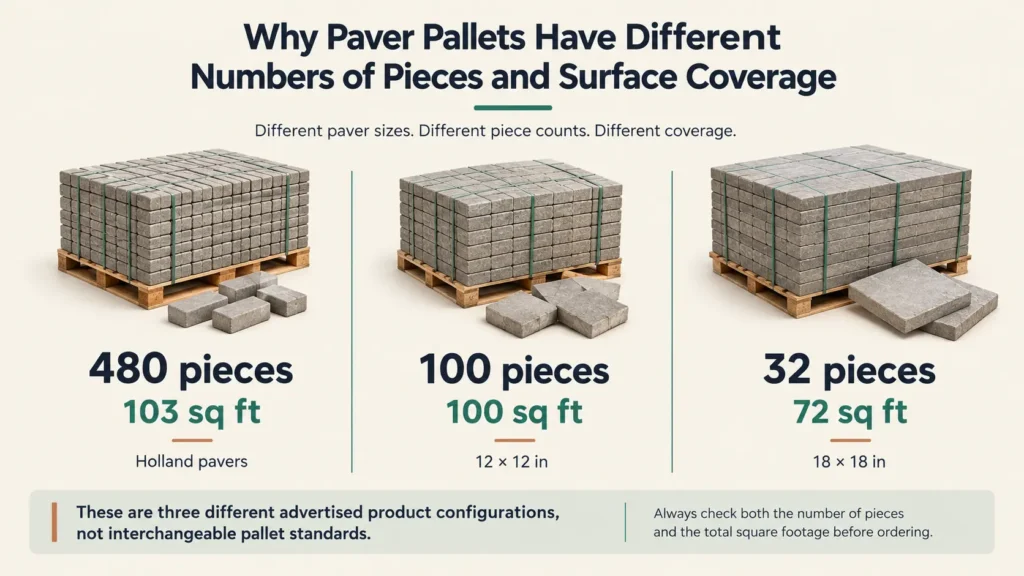
The answer can range from dozens to hundreds of pavers per pallet, depending on the exact product. For example, one Pavestone Holland listing specifies 480 pieces, while a Nantucket 18 × 18-inch patio-paver set contains 32 pieces. They are different products with different coverage, not two versions of one universal pallet size.
Start with the seller’s listing or manufacturer’s cut sheet. Look for “pieces per pallet,” “square feet per pallet,” “units per layer,” and the product or SKU number. Those numbers describe the package you can actually order.
Do not order using a generic pavers-per-pallet average. Two pavers that look similar online can be packed in different quantities. For a real purchase, use the exact product’s current specifications.
Real Paver Pallet Counts and Square-Foot Coverage
These are specific advertised product configurations, not industry averages. The coverage figures and piece counts below come from the linked retailer product listings. Confirm your selected color, SKU, location, and supplier packaging before ordering.
| Paver product (example) | Pieces / pallet | Published coverage |
|---|---|---|
| Pavestone Holland, 7.87 × 3.94 in | 480 | 103 sq ft (listed in product title) |
| Pavestone RumbleStone Square, 7 × 7 in | 288 | 98 sq ft |
| Nantucket Yorkstone, 12 × 12 in | 100 | 100 sq ft |
| Silver Creek Slate, 12 × 12 in | 44 | 44 sq ft |
| Nantucket Yorkstone, 18 × 18 in | 32 | 72 sq ft |
Notice the two 12 × 12-inch examples: one pallet contains 100 pieces and another only 44. Size alone cannot tell you how many pavers are on a pallet. Packaging can differ even when individual pavers have the same nominal face dimensions.
One additional warning: product-page headings, coverage banners, and local supplier listings may not always agree. If the square-foot figure differs across a listing, ask the seller for the current technical sheet rather than assuming either figure is correct.
Why Do Paver Pallet Quantities Vary?
Paver size changes the number of pieces
An 18 × 18-inch paver covers 2.25 sq ft before allowing for layout and joints, whereas a 12 × 12-inch paver covers 1 sq ft. If pallets deliver similar total surface coverage, larger pavers naturally require fewer pieces. But the overall coverage of the pallet does not have to be the same.
Thickness and weight affect packaging
Pavers of similar face dimensions can have different thicknesses and weights. A manufacturer or distributor may stack fewer heavy pieces on a pallet to meet packaging, handling, or transport limits. That is another reason you cannot infer pallet quantity from length and width alone.
Manufacturers sell by pallet, layer, bundle, or piece
Some products can be purchased individually or in layers, while others are supplied only as sealed pallet quantities. A decorative multi-size system might be sold as a pattern bundle with a stated total area rather than a useful single-piece count. The seller’s unit of sale directly affects your final order.
Nominal size is not always actual face size
A paver marketed as 4 × 8 inches may list slightly different physical dimensions. Spacers, specified joint widths, and laying patterns can also affect the declared installed coverage. Prefer the exact product’s published coverage over a calculation based only on a rounded marketing size, especially when ordering an entire pallet.
How to Calculate Pavers and Square Feet per Pallet
You can calculate a pallet order in either of two ways: by published coverage, if the supplier gives square feet per pallet, or by piece count, if you know the exact paver face dimensions and number of pieces per pallet. Both approaches need consistent units and an allowance for cuts.
Using published coverage:
Project area = length × width
Area including waste = project area × (1 + waste % ÷ 100)
Whole pallets = round up [area including waste ÷ square feet per pallet]
Using individual pieces:
Paver area (sq ft) = paver length (in) × paver width (in) ÷ 144
Required pieces = round up [project area × (1 + waste % ÷ 100) ÷ paver area]
Whole pallets = round up [required pieces ÷ pieces per pallet]
For example, a nominal 4 × 8-inch rectangular paver covers 32 ÷ 144 = approximately 0.2222 sq ft per piece. That is about 4.5 pieces per square foot before adding waste. If your product has actual dimensions different from 4 × 8 inches, use the actual dimensions or the manufacturer’s declared coverage instead.
Do not mix methods midway through the calculation. For a multi-size kit, use its published installed square-foot coverage and pattern instructions rather than treating the pallet as a bundle of identical rectangles.
Worked Example: How Many Pallets for a 12 × 15 ft Patio?
Suppose you want to cover a rectangular 12 × 15 ft patio using the Nantucket 12 × 12-inch Yorkstone pallet from the table above. Its listing identifies 100 pieces covering 100 sq ft per pallet. For this example, use a 5% waste allowance for ordinary cuts and breakage; adjust that allowance for your actual design.
- Project: 12 ft × 15 ft patio
- Area: 12 × 15 = 180 sq ft
- Waste allowance: 5%
- Selected pallet: 100 pavers / 100 sq ft
| Step | Calculation | Result |
|---|---|---|
| 1. Measure patio | 12 ft × 15 ft | 180 sq ft |
| 2. Include 5% waste | 180 × 1.05 | 189 sq ft |
| 3. Divide by pallet coverage | 189 ÷ 100 | 1.89 pallets |
| 4. Round up for whole-pallet purchase | Round 1.89 upward | 2 pallets |
| 5. See how much arrives | 2 × 100 sq ft | 200 sq ft (200 pavers) |
| 6. Compare with planned requirement | 200 − 189 | 11 sq ft / 11 pieces beyond the estimated need |
Result: two pallets. That purchase supplies 200 one-square-foot pavers for an estimated need of 189. The 11-piece difference is not a guaranteed repair reserve: some of the waste allowance may be consumed by cuts or breakage, and the amount actually left over can vary.
If the same seller offered a hypothetical price of $700 per pallet, two pallets would cost $1,400 for the pavers alone. That $700 is an illustrative number, not a current product quote. Shipping, taxes, base materials, and installation would be separate.
When a Small Shortage Means Another Whole Pallet
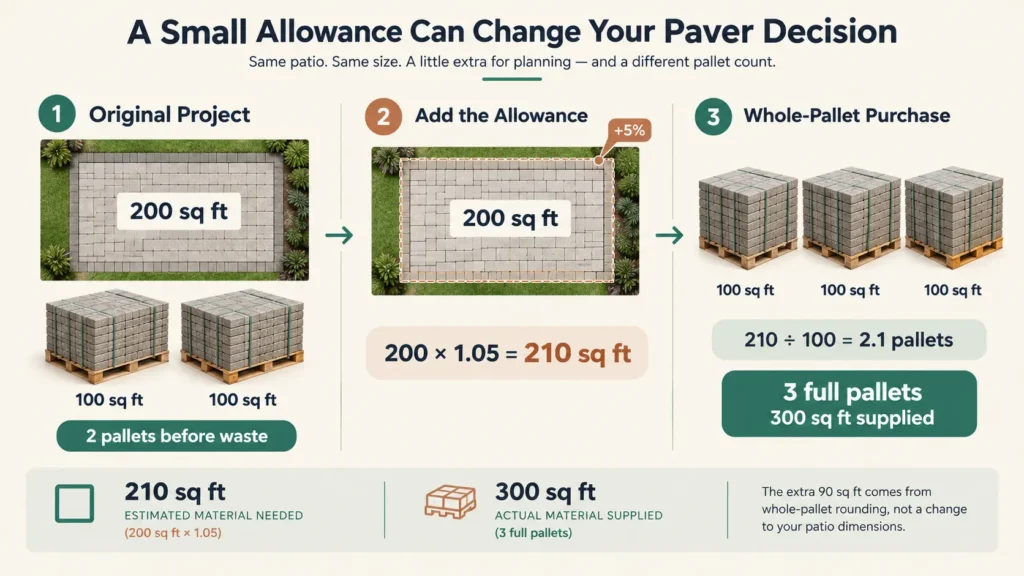
A pallet calculation is a purchasing calculation, not just a geometry problem. Consider a 200 sq ft patio using a product packaged at 100 sq ft per pallet:
- Without an allowance: 200 ÷ 100 = 2 pallets.
- With a 5% allowance: 200 × 1.05 = 210 sq ft.
- If full pallets are the only purchase option: 210 ÷ 100 = 2.1, so you would need 3 pallets.
Three pallets would supply 300 sq ft, considerably more than your estimated 210 sq ft requirement. Before paying for that extra pallet, ask whether your supplier can sell two pallets plus approximately 10 sq ft of matching loose pavers. The exact loose-piece count depends on the selected product and whether individual pieces are sold.
That option is not available for every product. Mixed-size kits, special orders, and factory-packed systems may need to be bought in complete bundles. Make the decision using availability, matching batch information, minimum purchase rules, and the total delivered price, not just the headline cost per pallet.
What If the Pallet Contains Different Paver Sizes?
A three-piece modular system can include several dimensions in one pallet. Dividing the total project area by the face area of just one size gives the wrong number of pieces and can lead to an invalid order.
For these systems, look for square feet per pallet and the manufacturer’s laying pattern. For example, Belgard Dimensions lists modular arrangements containing more than one paver size. Its pattern documentation and product cut sheets are more relevant than an assumed 4 × 8-inch piece count.
Our Paver Calculator is designed for a rectangular area covered with one rectangular paver size. It can calculate piece count and optional pallet rounding for that case. For a mixed-size kit, work from the manufacturer’s stated area coverage and any required pattern ratios instead.
What to Check Before You Order Paver Pallets
Before placing an order, use this short buying checklist to turn a rough estimate into a product-specific quantity:
- Match the exact SKU and finish. A different thickness, product line, or color can have different packaging.
- Verify installed coverage. Check the manufacturer’s cut sheet or confirm any inconsistent retailer coverage figures.
- Decide on a realistic waste allowance. Curves, cuts, borders, angled patterns, and damaged pieces may increase the quantity required.
- Confirm your unit of sale. Ask whether you must buy full pallets or can purchase layers or individual pieces.
- Check pallet weight and delivery access. Freight delivery, unloading, driveway access, and site storage can affect the purchase.
- Ask about matching production lots. Keeping material from the same run can be useful for visible repairs.
- Check returns and all-in cost. Consider shipping, handling, pallet deposits if applicable, returns, and the risk of a second delivery.
This guide only helps estimate the visible paving units. A real patio may also need excavation, a specified base, bedding material, edge restraints, drainage, and joint material. If you are estimating gravel volume separately, use the Gravel Calculator with a depth appropriate to your project specifications.
Frequently Asked Questions
How many 4 × 8-inch pavers are on a pallet?
It depends on the product. One Pavestone Holland listing for pavers marketed in this general size class specifies 480 pieces and labels the pallet at 103 sq ft. That is an example, not a standard count for every 4 × 8-inch paver. Confirm the actual dimensions and package specification.
How many square feet does a pallet of pavers cover?
There is no single coverage figure. The examples above range from 44 sq ft for a 44-piece Silver Creek pallet to 100 sq ft for a 100-piece Nantucket pallet, with other products advertised at 72, 98, or 103 sq ft. Use the declared coverage for the actual pavers you intend to purchase.
How many pallets of pavers do I need for 200 square feet?
If your product provides 100 sq ft per pallet, a 200 sq ft surface needs exactly two pallets before waste. With 5% waste, the estimate becomes 210 sq ft, or three full pallets if that is the only way the seller supplies it. If loose matching pavers are available, you may be able to avoid buying an entire third pallet.
Does paver thickness change the number of pieces per pallet?
It can. Thicker pieces often weigh more, and packaging can be limited by safe handling and freight requirements. Face dimensions and thickness both matter, but only the product’s packaging documentation tells you how many pieces will actually be shipped.
Can I buy a partial pallet of pavers?
Sometimes. A supplier may offer individual pavers, a layer, or a smaller bundle, while other products are sold only by full pallet or set. Ask about the unit of sale, matching stock, and delivery price before assuming a partial pallet is possible.
Should I buy extra pavers for future repairs?
Keeping a few usable matching pieces can be helpful, especially if the color, finish, or product may change over time. First look at the expected leftovers after waste and whole-pallet rounding. Do not automatically add a second full waste allowance without considering how much surplus the order already creates.
Calculate Your Pavers Before Buying a Pallet
The safest sequence is simple: measure the area, choose the exact paver, confirm its coverage and packaging, add a project-appropriate allowance, and round the final order to the seller’s unit of sale. The difference between 44 and 480 pieces per pallet shows why the last two steps matter.
Use our Paver Calculator to estimate the number of pavers for a single-size rectangular layout, add waste, and enter your verified pieces-per-pallet and optional pallet price. For mixed-size paving kits, follow the manufacturer’s published pattern coverage instead.
For other projects, you can also explore the full collection of HomeBuild Metrics calculators.