
FLOORS & TILE GUIDE
How Much Grout Do I Need? Calculate Bags and Coverage
To work out how much grout you need, start with your tiled area, tile length and width, grout-joint width, and joint depth. The same 100-square-foot floor can require very different amounts of grout depending on the tile layout and the product you choose. Square footage alone is not enough.
This guide explains grout coverage, shows a complete 100 sq ft calculation, compares an actual manufacturer coverage chart, and helps you turn a weight estimate into whole bags. For your own dimensions, use the HomeBuild Metrics Grout Calculator.
How Much Grout Do I Need? The Quick Answer
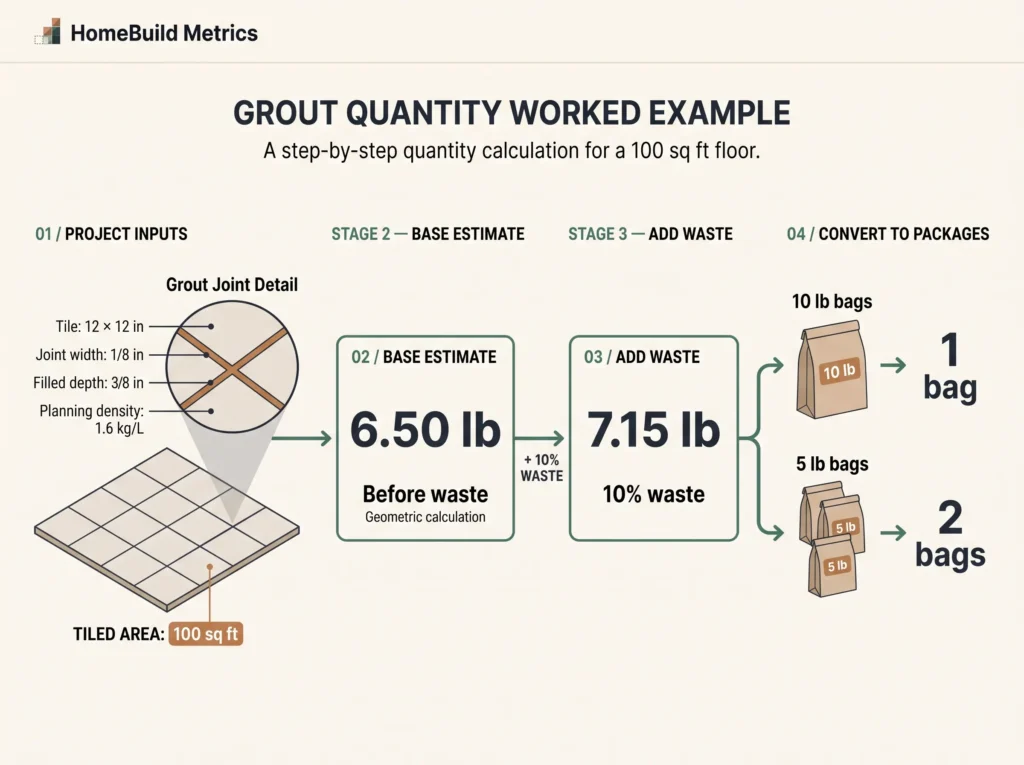
As a worked planning example, 100 sq ft of 12 × 12-inch tile, with 1/8-inch-wide and 3/8-inch-deep joints, uses approximately 6.50 lb of grout before waste when calculated with a 1.6 kg/L density factor. Adding 10% gives about 7.15 lb. If your chosen compatible grout is sold in 10 lb bags, that example rounds up to one bag.
That is not a standard amount for every 100 sq ft. A mosaic backsplash has many more grout joints than a floor covered with large-format tile. Different grout products also publish different coverage figures.
| What you need to know | Why it changes the estimate |
|---|---|
| Area being tiled | The total surface area sets the scale of the job. |
| Tile length and width | Smaller tile generally means more joints per square foot. |
| Joint width and fill depth | Wider or deeper gaps require more grout. |
| Grout product and packaging | Density, published coverage, and bag size affect the final order. |
| Waste allowance | A cushion helps account for spillage and cleanup losses. |
Best buying rule: Estimate the amount using your measurements, then check the coverage chart for the exact grout product. If its guidance differs from a general calculator, use the manufacturer’s product-specific information for your purchase.
If you are still working out your tile order rather than the grout order, calculate the tile count separately with our Tile Calculator. Tile cutting waste and grout consumption are different quantities.
How to Calculate Grout Quantity: Formula and Steps
A joint-volume estimate uses the tile dimensions to approximate the length of grout joints across the surface. It then multiplies that space by joint width, joint depth, and a grout density factor. The formula below follows the same geometric approach used by our Grout Calculator.
Grout consumption (kg/m²) = ((A + B) ÷ (A × B)) × C × D × K
A = tile length (mm); B = tile width (mm); C = filled joint depth (mm); D = joint width (mm); K = grout density factor (kg/L).
Total grout (kg) = consumption (kg/m²) × project area (m²)
Grout including waste = total grout × (1 + waste % ÷ 100)
Whole packages = round up [grout including waste ÷ weight per package]
- Measure the tiled area. A 10 ft × 10 ft floor is 100 sq ft. For multiple surfaces, calculate each surface and add them, excluding openings or untiled sections.
- Confirm the actual tile dimensions. A 2 × 2-inch mosaic and a 12 × 24-inch porcelain tile create very different joint lengths over the same area.
- Check joint width and fill depth. Width is the finished space between tile edges; fill depth is how deep the grout actually occupies that space.
- Use the product’s coverage or density data. Our calculator defaults to 1.6 kg/L as a planning factor, not as a specification for every grout.
- Allow for jobsite loss, then round up. Include appropriate spillage and cleanup allowance before converting weight into full bags or kits.
The Grout Calculator handles US-to-metric unit conversions, waste allowance, and optional package weight and price. It accepts tile thickness as a practical planning proxy when the actual grout-fill depth is unknown.
Grout Coverage Chart: How Many Square Feet Does a Bag Cover?
There is no single answer to “How many square feet does one bag of grout cover?” Each manufacturer’s chart is based on a specific grout formulation and package size. For example, CUSTOM Building Products publishes the following figures for its 17 lb box of Prism Ultimate Performance Grout:
| Tile size × thickness | Joint width | Approx. coverage per 17 lb Prism box |
|---|---|---|
| 2 × 2 × 1/4 in | 1/8 in | 96 sq ft |
| 12 × 12 × 3/8 in | 1/16 in | 688 sq ft |
| 12 × 12 × 3/8 in | 1/8 in | 348 sq ft |
| 12 × 12 × 3/8 in | 1/4 in | 177 sq ft |
| 12 × 24 × 3/8 in | 1/8 in | 461 sq ft |
Source: Prism product coverage chart, CUSTOM Building Products. These are the manufacturer’s published estimated coverage values for that product and package—not generic industry averages.
Notice that the 17 lb box is estimated to cover 348 sq ft with 12 × 12-inch tile and 1/8-inch joints, but only 96 sq ft with 2 × 2-inch tile and the same joint width (at the different thicknesses specified in the chart). Smaller tile creates far more joint length.
Do not swap this chart into another brand’s calculation. Even for matching dimensions, the consumption implied by a particular product’s coverage table can differ from a generic density-based estimate. Manufacturer coverage is also affected by real jobsite conditions.
Worked Example: How Much Grout for 100 Sq Ft of Tile?
Let’s calculate a hypothetical bathroom or kitchen floor with these inputs. This matches the dimensions of the example on our calculator page—not a specific commercial grout coverage claim.
- Tiled area: 100 sq ft (9.2903 m²)
- Tile size: 12 × 12 in (304.8 × 304.8 mm)
- Grout joint: 1/8 in wide (3.175 mm)
- Filled depth: 3/8 in (9.525 mm)
- Planning density: 1.6 kg/L
- Waste allowance: 10%
Step 1: Calculate grout use per square meter
((304.8 + 304.8) ÷ (304.8 × 304.8)) × 9.525 × 3.175 × 1.6 = 0.3175 kg/m².
Step 2: Multiply by the tiled area
100 sq ft = 9.2903 m². Multiply 0.3175 kg/m² by 9.2903 m² to get approximately 2.95 kg, or 6.50 lb, before waste.
Step 3: Add waste and round to packages
6.50 lb × 1.10 = approximately 7.15 lb. If the selected product is sold in 10 lb bags, 7.15 ÷ 10 = 0.715 bag, so round up to one 10 lb bag. If it is sold only in 5 lb bags, the same estimate needs two bags.
At an entered price of $25 per 10 lb bag, the example’s estimated grout material cost is $25. This is an illustrative price, not a live retail quotation.
What happens if the grout joint gets wider?
Keeping the same area, tile size, joint depth and density factor, the joint-width change makes a large difference:
| Joint width | Approx. grout incl. 10% waste | 10 lb bags required |
|---|---|---|
| 1/16 in | 3.58 lb | 1 |
| 1/8 in | 7.15 lb | 1 |
| 3/16 in | 10.73 lb | 2 |
| 1/4 in | 14.31 lb | 2 |
These are geometric illustration values; use the actual grout product’s published coverage and allowable joint widths to finalize the purchase. The bag count can jump sharply when a calculation passes a package-size threshold.
Why Tile Size, Grout Joint Width, and Depth Matter
Smaller tiles and mosaics create more grout joints
A surface covered with many small pieces contains far more lines of grout than one covered with large-format tiles. Even when two installations have identical square footage, mosaics can consume significantly more grout. Sheet-mounted mosaics also need careful attention to the actual joint spacing between sheets and individual pieces.
Wider grout joints increase the filled volume
With every other input fixed, the formula shows grout consumption increasing roughly in proportion to joint width. A 1/4-inch joint has about twice the estimated volume of a 1/8-inch joint in the same layout. The joint width should be determined by the tile, installation requirements and layout—not chosen to make a bag last longer.
The Tile Council of North America explains that grout-joint sizing depends on tile variation, edge shape, tile dimensions and the installation conditions. Check your selected tile and grout product before setting the joint.
Deeper joints hold more grout
A 3/8-inch-thick tile does not guarantee that every joint has a full 3/8-inch cavity available for grout. Setting material, tile-edge profiles and the installer’s joint preparation can change the actual filled depth. When you do not know that depth, using tile thickness is a useful estimate, not a measured fact.
Tile texture and installation method affect real-world loss
Textured, porous or irregular-surface tile can retain grout during installation and cleanup. Wide variations in joint depth and tile edges also affect coverage. Product manufacturers emphasize that coverage-chart values are estimates rather than guaranteed yields.
Grout for Bathroom Floors, Shower Walls, and Backsplashes
Bathroom floor: 40 sq ft example
A 5 ft × 8 ft bathroom floor has 40 sq ft of floor area before accounting for areas not tiled. If it uses 2 × 2-inch tiles that are 1/4 inch thick, with 1/8-inch joints and the same 1.6 kg/L planning factor, the geometry gives about 10.40 lb before waste, or 11.45 lb after 10% waste. That would round to two 10 lb bags—subject to the product’s own coverage guidance.
This is why it is risky to buy grout for mosaics based on a “one bag per bathroom” rule.
Shower walls: measure each wall separately
Calculate the tiled width × height for each wall, then combine the areas. Deduct significant untiled openings if appropriate, and measure shower niches, benches or returns that will be tiled. Shower-wall grout suitability and maintenance depend on the chosen system; grout itself is not a substitute for properly designed waterproofing.
Kitchen backsplash: measure the actual tiled height
A long backsplash can have modest square footage yet a high joint count if it uses small subway tile or mosaics. Multiply the actual backsplash length by the tiled height, subtract large untiled areas, and estimate with the correct tile dimensions. A window return or detailed edge can add tiled surfaces beyond the main wall.
How Much Extra Grout Should I Allow for Waste?
For a straightforward planning estimate, around 10% additional material can be a useful starting point for mixing, spillage and cleanup. LATICRETE’s grout coverage guidelines mention a 10% allowance for waste, spillage and cleanup, while noting that jobsite coverage varies.
It is not a universal requirement. Porous or rough tile, unusually complex work, deeper or inconsistent joints, and individual product recommendations can call for more careful allowances. Also remember that whole-bag rounding often adds material automatically.
Avoid adding waste twice. If a manufacturer’s ordering recommendation or package estimate already includes an allowance, check what is included before adding another 10%. Likewise, after rounding up to a whole bag, review the unused quantity before ordering a second package simply “for safety.”
Where color consistency is important, confirm that enough of the same grout product and color is available for the entire installation. Unmixed leftover product has storage and shelf-life limits; check the label rather than assuming an opened bag will remain suitable indefinitely.
How Many Bags or Tubs of Grout Should I Buy?
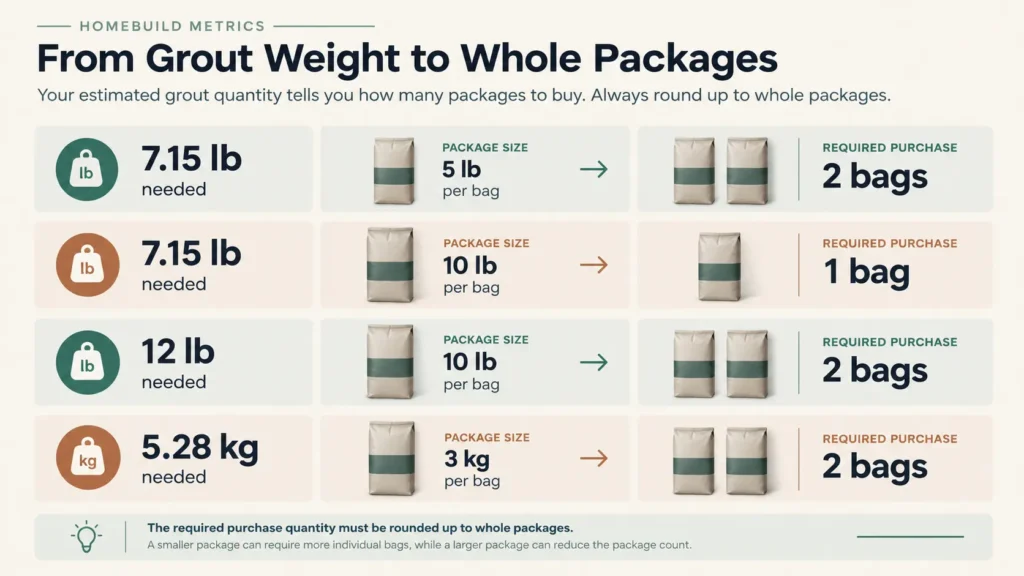
Once you have a grout weight estimate with waste included, divide by the product’s net usable package weight and round upward. For example, if your estimate is 12 lb and the compatible grout is sold in 10 lb bags, you need two bags. If the same product is offered in a larger package, compare total price and practical mixing needs.
| Estimated grout needed | Available package size | Minimum whole packages |
|---|---|---|
| 7.15 lb | 5 lb | 2 bags |
| 7.15 lb | 10 lb | 1 bag |
| 12 lb | 10 lb | 2 bags |
| 5.28 kg | 3 kg | 2 bags |
For premixed grout sold by volume, or multi-component epoxy grout sold as a kit, do not treat a gallon or kit as if it were a dry-weight bag. Follow that specific manufacturer’s coverage units and mixing instructions. The HomeBuild Metrics calculator’s optional package field is a weight input, so volume-only packaging needs its own product coverage conversion.
If you have the price per package, our calculator can estimate the purchase cost from the whole-pack count. Its currency selector formats the currency you enter; it does not perform an exchange-rate conversion.
Does Sanded, Unsanded, Epoxy, or Premixed Grout Change Coverage?
Yes. Grout products can differ in density, formulation, working method, packaging and published coverage. Two products with the same stated bag weight should not be assumed to cover the same square footage.
- Sanded or other cement-based grout: look up the specific product’s joint-width limits, tile compatibility, coverage chart and mixing directions.
- Unsanded grout: often used for narrower joints and certain surfaces, but product approvals matter more than a general rule of thumb.
- Epoxy or multi-component grout: use the system’s kit coverage; check the actual package units and installation directions.
- Ready-to-use or premixed grout: verify coverage per tub or pail and its approved application conditions; these products may be sold by volume rather than dry weight.
The TCNA grout FAQ provides background on joint-width considerations. For the final product selection, follow the exact grout manufacturer’s technical data sheet, especially for natural stone, polished tile, glass, showers and other demanding applications.
Before Buying Grout: A Practical Checklist
- Confirm all surfaces: floors, wall sections, shower niches and additional tiled returns.
- Use actual joint sizes: do not assume spacer size or nominal tile thickness always equals the finished joint dimensions.
- Check manufacturer coverage: identify the exact grout product and its stated package coverage.
- Use the right product: verify joint-width limits, tile compatibility, exposure and mixing requirements.
- Account for wastage once: allow for spillage and cleanup without automatically doubling an included margin.
- Round to real purchasing units: bags, pails or kits can have different package calculations.
- Keep movement joints out of grout estimates: joints at certain changes of plane or required movement locations need the appropriate flexible material, not rigid grout; follow the installation specification.
The TCNA guidance on changes of plane explains why sealant may be appropriate where surfaces move independently. Those joints should not simply be assumed to be ordinary grouted joints.
Frequently Asked Questions About Grout Quantity
How much grout do I need for 100 square feet?
It depends on tile dimensions, joint width and depth, and the product. In the 12 × 12-inch worked example above, our generic calculation gives approximately 7.15 lb including 10% waste. A manufacturer’s coverage chart for its own grout may give a different result.
How much grout do I need for 200 square feet?
If all other inputs stay the same, twice the tiled area needs roughly twice the calculated grout weight. The worked example would become about 14.31 lb with waste for 200 sq ft, but the number of bags depends on your chosen package size and product coverage.
How many square feet will a 10 lb bag of grout cover?
There is no universal square-foot coverage for a 10 lb bag. Tile size, grout-joint width, fill depth and product formulation all matter. Check the selected product’s coverage chart rather than estimating by bag weight alone.
Do smaller tiles use more grout?
Generally yes, for the same installed area, joint width and depth. Smaller tiles create more joint length across the surface. Mosaic sheets are a common example where a modest wall or floor area can use more grout than expected.
Can I use tile thickness instead of grout-joint depth?
Tile thickness can be a practical starting input when grout-fill depth is unknown, but it may overstate the space actually filled with grout. Where possible, use the real installed joint depth and follow the manufacturer’s coverage information.
Do I need grout between a wall and floor or at shower corners?
Those are often changes of plane where a suitable movement joint or flexible sealant is required instead of rigid grout. Follow the applicable tile installation details and product instructions rather than including every joint in a grout-weight calculation.
Can I use the same formula for regrouting?
Only if you know the depth and width of the joints you are actually refilling. A regrouting project may remove only part of the old material, so assuming the entire tile thickness as filled depth can overestimate consumption. Follow the grout manufacturer’s surface-preparation and minimum-removal guidance.
Do I add 10% before calculating bags?
Yes, if a separate 10% allowance is appropriate for the specific product estimate, apply it to the base grout weight first and then round up to whole packages. Check whether the manufacturer’s figure already incorporates its own allowance.
Calculate Your Grout and Package Quantity
Start with the actual tiled area, tile dimensions, joint width and grout-fill depth. Then compare your estimate against the grout brand’s coverage guidance and order the appropriate whole packages.
Use our Grout Calculator for US or metric measurements, adjustable density and waste, optional package weight, and estimated material cost. Planning the tiles too? Read How Much Extra Tile Should I Buy? to decide on a sensible tile overage before ordering boxes.
For other projects, browse the full collection of HomeBuild Metrics calculators.