
CONCRETE & OUTDOORS GUIDE
How Much Gravel Do I Need for a Paver Base?
To estimate gravel for a paver patio, multiply the base footprint by the planned compacted gravel depth, then convert the result into cubic yards or cubic meters. For example, a 20 × 10 ft patio with a 6-inch compacted aggregate base needs about 3.70 cubic yards of finished base volume before any adjustment for ordering and compaction. The actual amount to purchase depends on the aggregate, site conditions, supplier, and whether its quoted volume is loose or compacted.
This guide explains how to choose an appropriate design depth, calculate gravel volume and weight, and avoid confusing the aggregate base with bedding sand or the pavers themselves. Use our Gravel Calculator to run your own measurements.
Quick Answer: Gravel Needed for a Paver Base
A paver base is not a single fixed thickness. Guidance varies by traffic, subgrade, drainage, climate, and paver system. For a conventional pedestrian patio, published manufacturer guidance often begins around 4–6 inches, while other installation guides specify 6–8 inches or more. Vehicle loads and weak or clay-rich soil can call for substantially deeper assemblies. These are examples from different installation systems, not interchangeable rules.
| Source and situation | Published base guidance | Important qualification |
|---|---|---|
| Belgard: pedestrian patios and sidewalks | 4 in minimum in its installation table | The same guide includes a typical assembly diagram showing 6 in aggregate; site conditions control. |
| Belgard: residential driveways | 6 in minimum in its installation table | Specific installations can require more. |
| Unilock: patios and walkways | 6–8 in in its 2024 planning guide | Drainage, soil, and product specifications may change the requirement. |
| Unilock: driveways | 10–14 in in its 2024 planning guide | Do not apply pedestrian guidance to vehicles. |
Sources: Belgard Installation Guide and Unilock Basic Technical Guide. Check the exact paver manufacturer and local installation requirements before setting depth.
Important: the calculator’s starting values are calculation examples, not engineering recommendations. Choose the required compacted depth before estimating the material.
What Counts as Gravel Base—and What Does Not?
A typical conventional paver installation includes several separate layers. Buying the gravel base without accounting for the other layers can produce the wrong excavation depth and total budget.
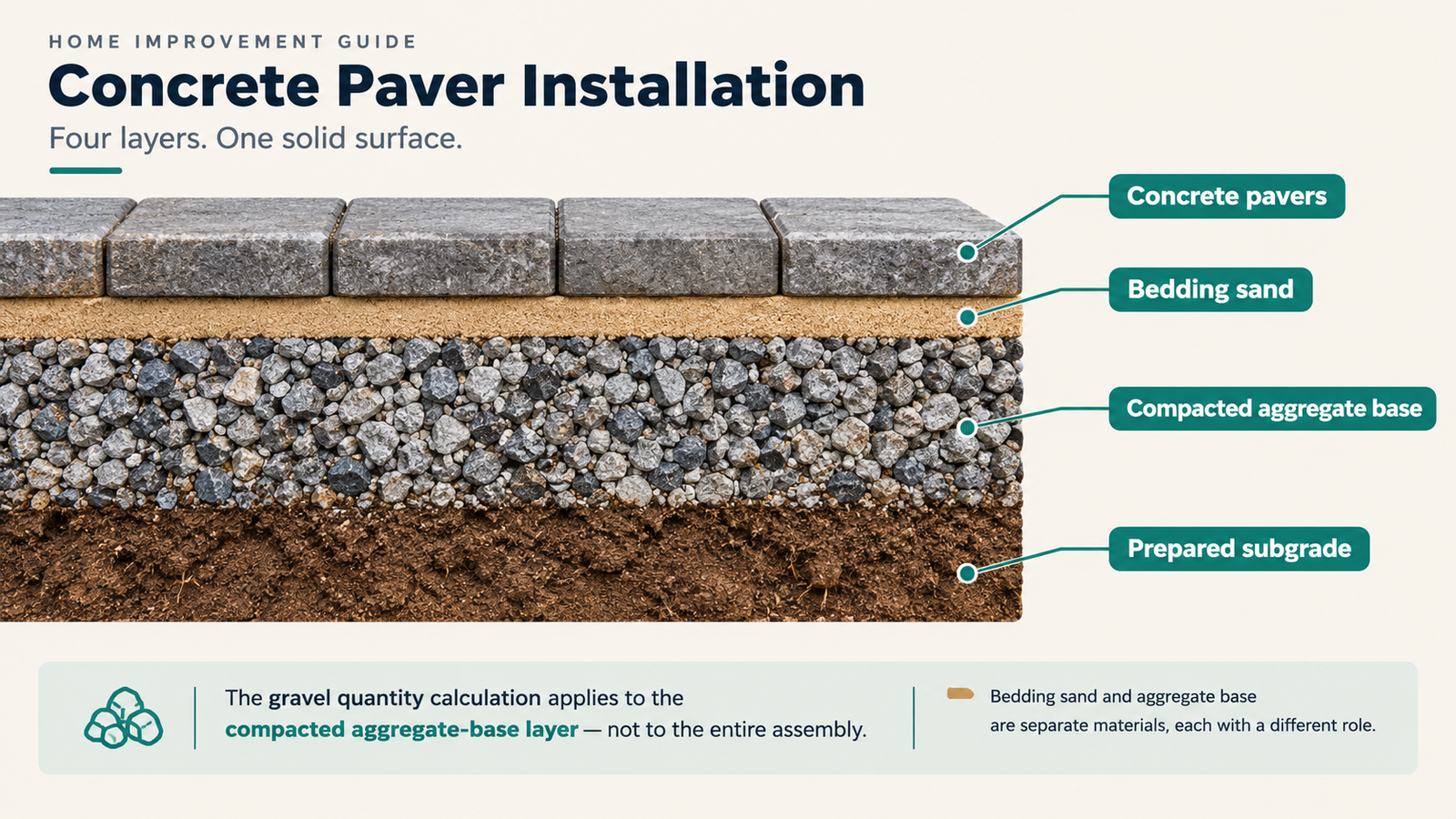
- Compacted subgrade: the prepared soil beneath the pavement system.
- Aggregate or gravel base: a specified, compacted layer that distributes loads and provides stable support.
- Bedding course: often roughly 1 inch of suitable bedding sand in a conventional system, installed above the base.
- Pavers: the finished surface, with a thickness determined by the chosen product.
- Joint material and edge restraints: separate components that help the installed pavement perform as designed.
For a conventional example using 6 inches of compacted base, 1 inch of bedding sand, and 2⅜-inch pavers, the nominal layer thickness totals 9⅜ inches below the intended finished paver surface. Excavation allowances for subgrade correction, slope, or drainage may change the actual excavation plan. Do not simply add sand thickness to the gravel quantity.
Permeable pavement systems can use a different open-graded stone base and bedding material. Follow the specifications for that system rather than applying conventional dense-graded base guidance.
How to Calculate Gravel for a Paver Base
The basic calculation works in either US or metric units as long as the dimensions use compatible units.
Square feet: Length (ft) × width (ft) = base area (sq ft)
Cubic feet: Base area (sq ft) × compacted depth (in) ÷ 12
Cubic yards: Cubic feet ÷ 27
Metric: Area (m²) × compacted depth (m) = cubic meters (m³)
Estimated US short tons: estimated purchase volume (cu yd) × supplier bulk density (short tons/cu yd)
For L-shaped or irregular patios, split the base into rectangles, calculate each separately, and add the volumes. If the gravel extends beyond the visible paver edge to support edge restraints, measure the actual aggregate base footprint, not just the finished paver surface.
The HomeBuild Metrics Gravel Calculator accepts length, width, depth, optional waste allowance, bulk density, and price per ton. Because it models a rectangular area at a consistent depth, calculate distinct zones separately if your base has variable depths.
Worked Example: 20 × 10 ft Patio With a 6-Inch Base
Assume a rectangular patio base footprint of 20 ft × 10 ft, and a specified final compacted aggregate thickness of 6 inches. This is an example only—not a recommendation that every patio needs a 6-inch base.
- Area = 20 × 10 = 200 sq ft.
- Depth = 6 ÷ 12 = 0.5 ft.
- Compacted base volume = 200 × 0.5 = 100 cu ft.
- Compacted volume in cubic yards = 100 ÷ 27 = 3.70 cu yd (rounded).
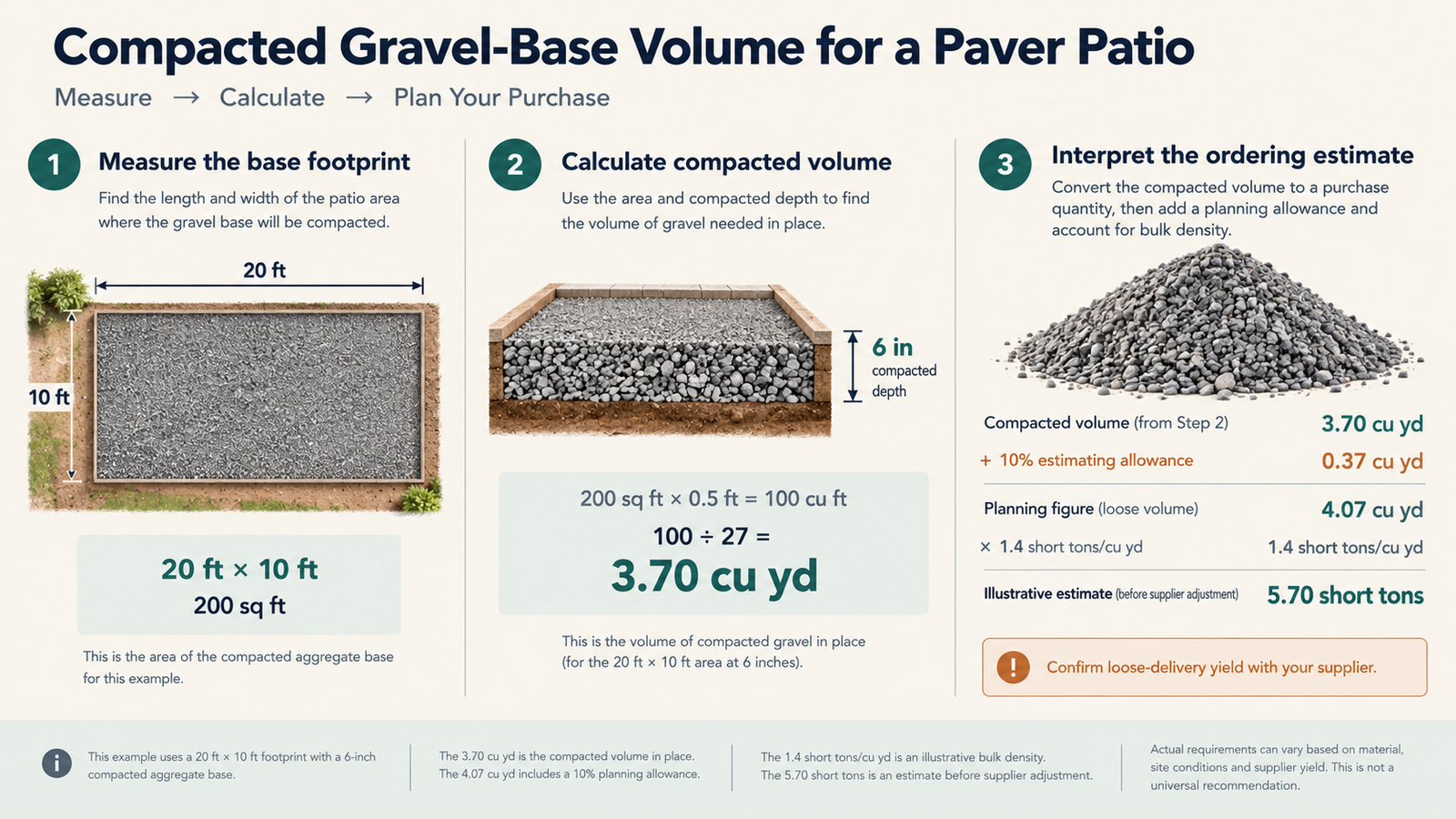
If you use a provisional 10% estimating allowance, 3.7037 × 1.10 = 4.07 cubic yards. However, 4.07 is only a planning figure: it is not a verified loose-delivery quantity. Ask your supplier how its measured material relates to the compacted base you need.
At an illustrative bulk density of 1.4 US short tons per cubic yard, 4.0741 × 1.4 = 5.70 short tons before any supplier-specific adjustment. The density is a placeholder, not a specification for every crushed aggregate.
| Specified compacted base depth | Volume for 200 sq ft | With illustrative 10% allowance |
|---|---|---|
| 4 in | 2.47 cu yd | 2.72 cu yd |
| 6 in | 3.70 cu yd | 4.07 cu yd |
| 8 in | 4.94 cu yd | 5.43 cu yd |
The table illustrates the arithmetic only. Do not select the depth based on which material quantity fits your budget.
How Many Tons of Gravel Is That?
A cubic yard measures volume; a ton measures weight. The conversion depends on the aggregate’s bulk density, particle-size distribution, moisture, and how the supplier measures its product. The Gravel Calculator uses 1.4 short tons per cubic yard as a general default in US mode, but the precise product may differ.
For example, if a supplier quotes 1.5 short tons per cubic yard, a 4-cubic-yard volume estimate corresponds to approximately 6 short tons. If that supplier instead quotes a documented coverage rate for a specified compacted depth, follow its guidance.
In the United States, a short ton = 2,000 lb; a metric tonne = 1,000 kg. Check units before comparing prices or transferring figures to a delivery order.
What Kind of Gravel Should Go Under Pavers?
For conventional interlocking concrete pavers, many manufacturers specify a graded, compactable crushed aggregate rather than decorative pea gravel. Belgard describes a conventional base of crushed gravel ranging from around ¾ inch down to fines; Unilock’s planning guide references ¾-inch crusher run or another approved base material.
Names vary by region: you may hear “crusher run,” “dense-graded aggregate,” “road base,” or “paver base.” The name alone does not prove that the gradation, durability, or drainage characteristics suit the installation. Ask the supplier for the material specification that matches your manufacturer’s system.
Open-graded/permeable paver systems commonly use different stone gradations and bedding details; do not mix and match layers from the two designs. See Belgard’s base-preparation guidance and Unilock’s paver base guide for examples of why system selection matters.
Compaction: Why the Delivered Quantity May Differ
The volume calculated from finished dimensions describes the compacted layer in place. Loose aggregate delivered by truck can settle or compact to a different final volume. There is no reliable single compaction multiplier for every aggregate and site.
Some estimators add 10% as a general allowance for measurement uncertainty or handling loss, but that percentage should not be presented as a guaranteed conversion from loose to compacted volume. Ask the supplier or installer for the appropriate loose-to-compacted yield and whether the material is sold by weight or by loose truck volume.
For conventional dense-graded aggregate, Unilock advises compacting in lifts rather than placing an entire thick layer at once; its consumer guide describes roughly 3–4-inch layers for typical plate compactors. Equipment, aggregate, and project specifications still control the actual lift thickness and compaction target. Read Unilock’s base preparation guidance.
Should You Buy Bags, Cubic Yards, or Tons?
Small repairs may be manageable with bags, but full patios usually need enough aggregate that bulk delivery is worth comparing. Convert the calculated volume to the supplier’s selling unit, then consider minimum orders and delivery charges.
- Bulk by cubic yard: confirm whether volume is measured loose at loading or as a stated compacted yield.
- Bulk by ton: use the supplier’s density to translate the required base volume into a weight estimate.
- Bagged base: use the bag’s stated coverage or volume; do not assume bags with equal weight have equal volume.
- Delivery: check minimum quantities, truck access, placement location, and whether delivery is included in the quoted price.
You can estimate visible pavers separately with the Paver Calculator. If your supplier sells pavers by pallet, compare the exact product’s pallet coverage and piece count before placing an order.
Common Mistakes When Ordering Paver Base Gravel
- Using finished paver area when the aggregate extends past the edge. Base support may need a wider footprint.
- Confusing excavation depth with base depth. Excavation must account for the selected gravel base, bedding, pavers, and site preparation.
- Choosing depth from a generic blog chart. Use site, product, and load requirements.
- Multiplying finished compacted volume by an arbitrary “compaction factor.” Get material-specific information.
- Ordering decorative gravel instead of specified base aggregate. Gradation and compactability matter.
- Ignoring drainage and weak subgrade. Persistent moisture, clay, and vehicle loads can change the system design.
- Pricing only the aggregate. Bedding, edge restraints, equipment, geotextile where required, delivery, and labor can be separate costs.
Frequently Asked Questions
How much gravel do I need for a 200 sq ft patio?
At a specified 6-inch compacted base depth, 200 sq ft requires about 3.70 cubic yards of finished base volume. Your purchase quantity may differ due to base footprint extensions, supplier yield, and other job conditions.
Is 4 inches of gravel enough under pavers?
Some conventional pedestrian applications have manufacturer minimums around 4 inches, but other systems or site conditions specify 6–8 inches or more. Four inches should not be assumed adequate without checking the chosen paver system, soil, drainage, and local requirements.
How deep should gravel be under driveway pavers?
Driveway bases generally need more support than pedestrian patios. Manufacturer tables differ: some list a 6-inch minimum while others recommend 10–14 inches depending on system and conditions. Use the applicable product and site specifications.
Do I count bedding sand as gravel base?
No. For a conventional system, estimate the compacted aggregate base and the bedding layer separately. Their materials and thicknesses serve different purposes.
Can I use pea gravel as paver base?
Loose rounded pea gravel typically does not act like specified compactable crushed aggregate. Follow the material requirements for your particular pavement design.
Does the gravel calculator account for compaction?
It estimates volume from the depth you enter and applies an optional allowance. It cannot independently predict the loose-to-compacted yield of a specific aggregate. Enter the design depth and confirm the final purchase amount with the supplier.
How do I calculate gravel for an L-shaped patio?
Divide the actual aggregate base footprint into nonoverlapping rectangles, calculate the area and volume of each, and add the results. Use separate calculations for sections with different depths.
How much does paver base gravel cost?
Multiply the supplier-quoted purchase quantity by its price per cubic yard or ton, using matching units. Add delivery and other charges; the site calculator’s cost estimate is only for the material rate you enter.
Sources and Further Reading
This guide uses manufacturer documentation for installation examples and treats the gravel quantities as calculations rather than product-specific purchase guarantees.
- Belgard — Product Installation Guide (PDF): layer diagram, base requirements, and installation conditions.
- Unilock — Basic Technical Guide (PDF): base depth ranges and material system examples.
- Belgard — Installing a Proper Paver Base: aggregate type, bedding, and excavation considerations.
- Unilock — Base Preparation: compaction lifts, drainage, and common errors.
Calculate Gravel for Your Project
Start with the compacted base depth specified for your site and paver system. Enter the footprint, depth, and material density in our calculator, then confirm the loose delivery quantity or weight with the supplier before ordering.
Planning the entire patio? Also visit the Paver Calculator to estimate the visible pavers, or explore our Calculators Hub.