
How Many Pavers Do I Need for a Patio?
To estimate how many pavers you need, divide your patio’s finished square footage by the area covered by one paver, then allow for cutting and breakage. For example, a 100-square-foot patio using idealized 4 × 8-inch pavers requires 450 pieces before waste, or 473 pieces with a 5% allowance. The actual number can change with the product’s installed coverage, joint spacing, pattern, and edge cuts.
This guide explains how to calculate the count for standard rectangular pavers, when the simple formula is reliable, and what to check before buying. For a quick estimate using your dimensions, open the HomeBuild Metrics Paver Calculator.
Measure the finished patio footprint, not the excavation
Start with the surface you want to see when the patio is finished. For a simple rectangular patio, measure the finished length and width in feet and multiply them. A 14 × 12 ft patio covers 168 square feet. A 10 × 10 ft patio covers 100 square feet.
Do not use the larger excavation or aggregate-base dimensions in the paver-count calculation. Base material sometimes extends beyond the visible edge for support, but the extra base does not mean extra surface pavers.
- Rectangle: finished length × finished width.
- L-shaped patio: split into nonoverlapping rectangles and add their square footage, or calculate the outer rectangle minus the missing corner.
- Curved edge: sketch and measure the curved footprint as closely as practical; cuts can increase waste even after you know the area.
- Built-in planter or large unpaved space: subtract its area only if no pavers will cover it. Account for any separate edge or border pieces.
Measure in consistent units, and note where the design will change direction or use a different paver. If you have a multi-size laying pattern, one total area is not enough to determine how many of each size to order.
Pavers per square foot: common size comparisons
For a single rectangular paver size, divide 144 square inches by the paver’s face length × face width in inches. This gives the idealized number of pieces per square foot. It does not explicitly account for installation joints, irregular shapes, or the supplier’s declared installed coverage.
| Illustrative paver face size | Pieces per sq ft (approx.) | Pieces for 100 sq ft | With 5% extra |
|---|---|---|---|
| 4 × 8 in | 4.50 | 450 | 473 |
| 6 × 6 in | 4.00 | 400 | 420 |
| 6 × 9 in | 2.67 | 267 | 280 |
| 8 × 8 in | 2.25 | 225 | 237 |
| 12 × 12 in | 1.00 | 100 | 105 |
| 16 × 16 in | 0.56 | 57 | 60 |
Table assumptions: the sizes are treated as exact rectangular face dimensions; no joint-space adjustment is applied. Quantities are rounded up to whole pavers, and the 5% allowance is applied to the unrounded area calculation before the final round-up. These are examples, not confirmed installed coverages for specific products.
A product marketed as “4 × 8 in” may not have an actual 4 × 8-inch face. Lowe’s paver-planning guide specifically warns that common or nominal sizes can differ from actual dimensions. If your supplier lists square feet per layer, bundle, or installed paver, use that product-specific figure for the final order rather than assuming the simplified table applies.
The paver-count formula, step by step
Once you know the finished patio area and the paver’s nominal face dimensions, the simplified area estimate is straightforward:
- Patio area (sq ft) = length (ft) × width (ft)
- Paver face area (sq ft) = length (in) × width (in) ÷ 144
- Base number of pavers = round up [patio area ÷ paver face area]
- Pavers with allowance = round up [(patio area ÷ paver face area) × (1 + waste % ÷ 100)]
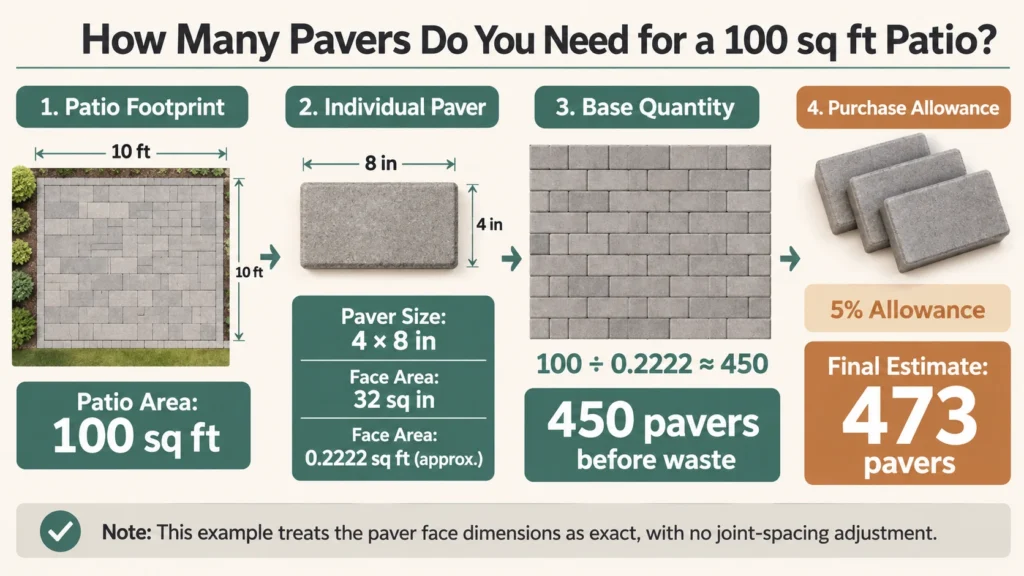
The waste allowance is added before the final round-up. This matches the method described on our Paver Calculator page. It gives an area-based purchase estimate, not an exact row-by-row cutting schedule.
Metric version: For a 4 m × 3 m patio and idealized 20 × 10 cm rectangular pavers, the patio area is 12 m². Each paver covers 0.20 × 0.10 = 0.02 m², so 12 ÷ 0.02 = 600 pavers. With 5% extra, the result is 630 pavers. The same joint and product-coverage cautions apply in metric units.
Worked patio example: 14 × 12 ft with 6 × 9-inch pavers
Assume a rectangular patio with these planning inputs: 14 ft length, 12 ft width, one 6 × 9 in rectangular paver, and an illustrative 8% waste allowance. This example ignores joint spacing and uses the stated face dimensions exactly.
- Patio area: 14 × 12 = 168 sq ft.
- Single-paver area: (6 × 9) ÷ 144 = 0.375 sq ft.
- Pieces without waste: 168 ÷ 0.375 = 448 pavers.
- With 8% extra: 448 × 1.08 = 483.84, rounded up to 484 pavers.
Here is how the final order responds when you adjust the allowance without changing the patio or paver size:
| Planning allowance | Calculated pieces to purchase | What it represents |
|---|---|---|
| 5% | 471 | Illustrative low-cut layout allowance |
| 8% | 484 | Example used above |
| 10% | 493 | A more conservative example for cuts and breakage |
For the same hypothetical project, a seller offering 250 matching pavers per bundle would require two whole bundles to cover the 484-piece estimate, providing 500 pavers. The difference between 484 needed and 500 supplied is packaging surplus, not additional installed surface area.
A completed layout may need fewer or more pieces than this simplified count, especially when the real paver dimensions differ or the edge cuts do not reuse neatly. Confirm the product’s installed coverage and the laying plan before placing a large order.
How pattern, borders, and curves change the order
The face-area calculation describes how much surface the pieces can cover. It does not know where each paver is cut. A straight-edged patio with a simple running bond often produces different offcuts from a diagonal herringbone patio with a curved border. Belgard’s pattern guide illustrates why laying patterns vary so much in arrangement.
- Running bond or simple straight grid: full pavers can often fill most of the field; perimeter cuts determine much of the waste.
- Herringbone or diagonal layouts: more pieces meet the perimeter at an angle, which can create extra cuts and unusable offcuts.
- Curved patios: tight radii, corners and small insets may consume more pieces than the area calculation suggests.
- Contrasting borders: count the border product separately; deduct its actual footprint from the inner field if it uses a different paver.
- Three-size modular sets: follow the supplier’s pattern ratio and installed coverage. Dividing total area by one hypothetical average paver does not tell you how many of each unit to buy.
How much waste should you allow? Romanstone’s installation instructions describe 5% for cutting and breakage in its planning example, while Lowe’s suggests purchasing 10% more. Neither percentage is a universal requirement. Our calculator starts at 5%, which you can adjust to reflect the actual layout, product and installer’s recommendations.
One common mistake is subtracting the space between pavers twice. Some manufacturer coverage figures already reflect the installed pattern and joint spaces. Do not add a separate joint-area correction on top of a published square-feet-per-layer figure unless the manufacturer specifically instructs you to. Our calculator does not offer a dedicated joint-width field.
Example: counting pavers for an L-shaped patio
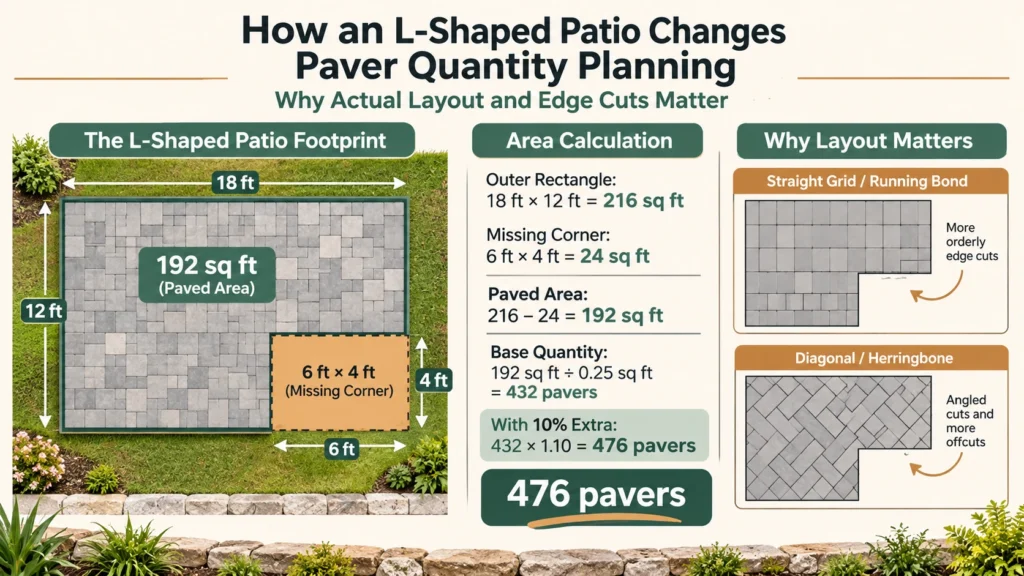
Suppose the finished paved outline fits inside an 18 × 12 ft rectangle, but an unpaved 6 × 4 ft corner has been removed. You plan to use idealized 8 × 8-inch pavers and allow 10% extra for cuts along the inner corner.
- Outer rectangle: 18 × 12 = 216 sq ft.
- Missing corner: 6 × 4 = 24 sq ft.
- Paved area: 216 − 24 = 192 sq ft.
- Coverage rate: 144 ÷ (8 × 8) = 2.25 pavers per sq ft.
- Base quantity: 192 × 2.25 = 432 pavers.
- With 10% extra: 432 × 1.10 = 475.2; round up to 476 pavers.
Because our Paver Calculator accepts one rectangle per calculation, use separate nonoverlapping rectangular zones for a complex footprint, then combine the unrounded quantities or area totals before applying a final purchasing allowance where practical. Confirm actual cut requirements from the planned layout; this arithmetic does not predict the shape of corner cuts.
If the patio has a different border paver, estimate the border and inner field as separate products. Subtract the border footprint from the field so the same area is not counted twice.
Turn the paver count into a real purchase order
Before you place the order, match the calculated piece count to the way your exact paver is sold. A retailer may sell individual pieces, layers, packs or full pallets. If the listing provides square feet of installed coverage per bundle, that can be more useful than a theoretical number of pieces per square foot.
- Check the exact product and color: “6 × 9 paver” is not enough to establish actual installed coverage or packaging.
- Confirm layer or bundle quantities: divide required pieces by pieces per package and round up only if you must purchase whole packages.
- Ask about loose pieces: one extra partial layer may be more economical than a whole additional pallet.
- Confirm availability and matching production lots: replacement pieces bought later may not match the original color or finish perfectly.
- Compare the full quote: delivery, deposits, returns, joint material, base construction and labor are not included in a simple paver-piece estimate.
Our existing guide on how many pavers come on a pallet covers the packaging side in detail. The Paver Calculator can also convert a recommended piece count to whole packages and calculate an optional material cost from the package quantity and price you enter. Currency selection labels your entered price; it does not convert exchange rates.
Pavers are only one part of the patio materials list
This quantity estimate covers the visible paving units. It does not calculate excavation, compacted aggregate base, bedding material, joint sand, edge restraints, drainage or labor. Those are separate material and installation decisions.
A patio’s gravel-base footprint may extend past the finished paver edge, and the correct compacted depth depends on the chosen system and site conditions. Use our guide to calculating gravel for a paver base when planning that layer; do not assume the paver count determines the gravel volume.
For unconventional or permeable paving systems, follow the manufacturer’s system-specific guidance for installed coverage, joints, bedding and drainage. A single-size surface-area estimate is not a substitute for those specifications.
Questions homeowners ask before buying patio pavers
How many pavers do I need for a 10 × 10 ft patio?
A 10 × 10 ft patio covers 100 sq ft. Using idealized 4 × 8-inch pavers with no separate joint-space correction, you need 450 pieces before waste, or 473 with a 5% allowance. Confirm product coverage and layout before ordering.
How many 12 × 12-inch pavers do I need for a 12 × 12 ft patio?
The patio covers 144 sq ft. A true 12 × 12-inch face is one square foot, giving 144 pavers before waste, or 152 with a 5% allowance. This assumes the specified face size is suitable for the area method; actual product coverage may differ.
Do I need more pavers for herringbone than for running bond?
The paved area stays the same, but a herringbone pattern can generate more offcuts at the edges, especially when laid diagonally. Extra material depends on the edge geometry, paver dimensions and installer’s cutting plan; there is no universal extra percentage for every herringbone patio.
Should I include the gap between pavers in the formula?
Check how the manufacturer defines the size and coverage. The simplified calculator uses the paver face area and does not have a separate joint-width input. For a product with stated installed square footage per layer or pallet, prefer the declared coverage so you do not miscount joint space or add it twice.
Can I calculate circular or mixed-size patios with the Paver Calculator?
The tool is designed for one rectangular paver size and one rectangular project area per calculation. For nonrectangular patios, calculate separate areas and check cutting allowances. For mixed-size kits, use the manufacturer’s laying pattern and coverage per product size.
Sources and estimating assumptions
The example counts use exact square-foot and square-inch conversions. Technical buying and installation caveats are informed by these manufacturer and retailer resources:
- Lowe’s: Planning for a Paver Patio or Walkway — area formulas, actual versus nominal dimensions and a 10% purchase allowance.
- Unilock: Paver Calculator FAQ — mixed-size layouts, product-specific ratios, bundles and patterns.
- Belgard: Paver Pattern Guide — running bond, herringbone, basketweave and mixed-format layouts.
- Romanstone: Concrete Paver Installation — layout measurement, cutting and a 5% example allowance.
The 8% and 10% worked-example allowances are assumptions used to illustrate purchasing arithmetic, not product-specific recommendations. Face-area tables ignore explicit joint adjustments. Where a product’s published installed coverage conflicts with simplified calculations, use its documented coverage and installation instructions.
Calculate your patio pavers before buying
Enter the actual finished patio size, one rectangular paver size, your chosen waste allowance and optional package details. Check the result against your supplier’s installed coverage and laying plan before placing the order.
For other home projects, explore our calculators and project guides.