
How Much Wallpaper Do I Need?
To calculate how many rolls of wallpaper you need, measure the width and height of the walls you want to cover, estimate how many full-height strips you need, then see how many strips fit on each roll. Pattern repeat and trimming can make the buying quantity significantly higher than a simple square-foot calculation.
For a room with patterned wallpaper, the HomeBuild Metrics Wallpaper Calculator estimates strips, rolls, and optional material cost. This guide shows you how to check that estimate before ordering.
Start by measuring the walls, not the floor
Wallpaper is normally hung in vertical strips. You need the total horizontal width of the wall surfaces and the height each strip must cover. Measure each wall in feet and inches, or meters and centimeters, and make a simple sketch.
If all four walls of a rectangular room will be papered, the wall perimeter = 2 × (room length + room width). A 14 ft × 11 ft room has a 50-ft perimeter. With 8-ft walls, that is 400 sq ft of gross wall area, but gross square footage is not the same as the amount of usable wallpaper.
- For one accent wall: measure only that wall’s width and height, not the entire room perimeter.
- For a whole room: add the widths of all walls being covered. The perimeter formula works only for a rectangular room with all four walls included.
- For uneven ceilings: check the tallest required strip height and allow cutting room.
- For stairwells, sloped walls, or interrupted sections: calculate separate wall zones rather than using an average height.
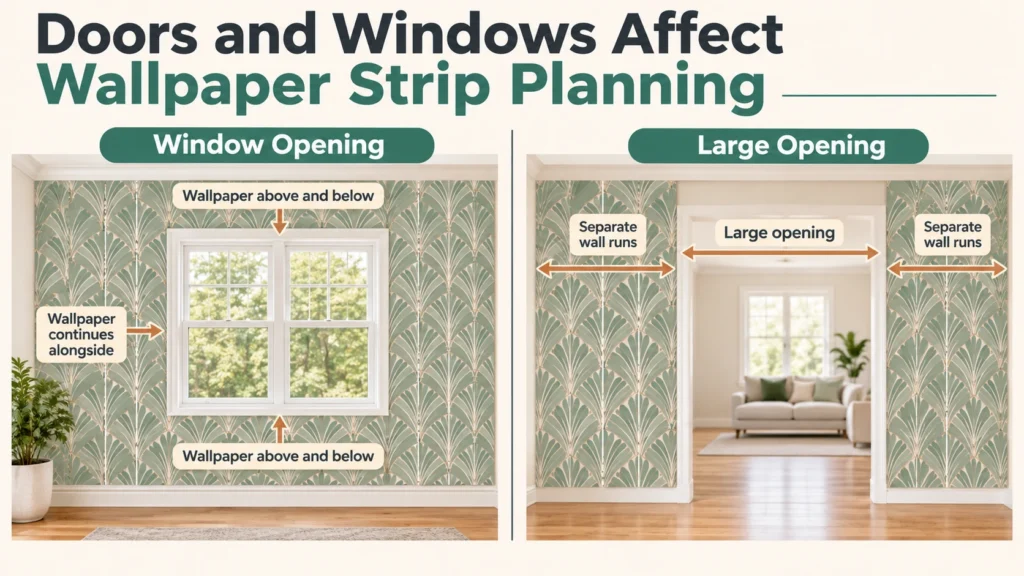
Also record doors, windows, large openings, and sections you will not wallpaper. They matter for layout, although a window rarely removes the need for every strip that passes above or below it.
Why a 56-square-foot roll may cover much less wall
A wallpaper label gives the material area on the roll. That is useful when comparing products, but full-height strip cutting wastes some of it. A short offcut at the bottom of a roll usually cannot cover a full wall, even though it still counts toward the advertised square footage.
For example, York Wallcoverings identifies a 20.5-in-wide × 33-ft-long product as a double roll with about 56.4 sq ft of material. Four exact 8-ft strips would consume 32 ft. If each strip requires just 4 extra inches for trimming, four strips would require 33 ft 4 in, which no longer fits. Only three complete strips fit under that trim assumption.
| Example roll format | Gross material area | Buying implication |
|---|---|---|
| 20.5 in × 33 ft | 56.4 sq ft | A double-roll example from York; usable strips depend on height and repeat. |
| 20.5 in × 16.5 ft | 28.2 sq ft | Half-length arithmetic example, not a universal retail package. |
| 52 cm × 10 m | 5.20 m² (about 56 sq ft) | Metric example; always use the exact product dimensions. |
Single roll vs double roll wallpaper: naming and selling units vary. The Wallcoverings Association explains that wallpaper can be priced by a single-roll measure yet packaged as double or triple rolls. Compare actual width, length, package quantity and price, not only the wording on a listing.
For peel-and-stick wallpaper, extra-wide products, and custom murals, standard roll assumptions may not apply. Follow the exact manufacturer format.
Pattern repeat can change the number of strips per roll
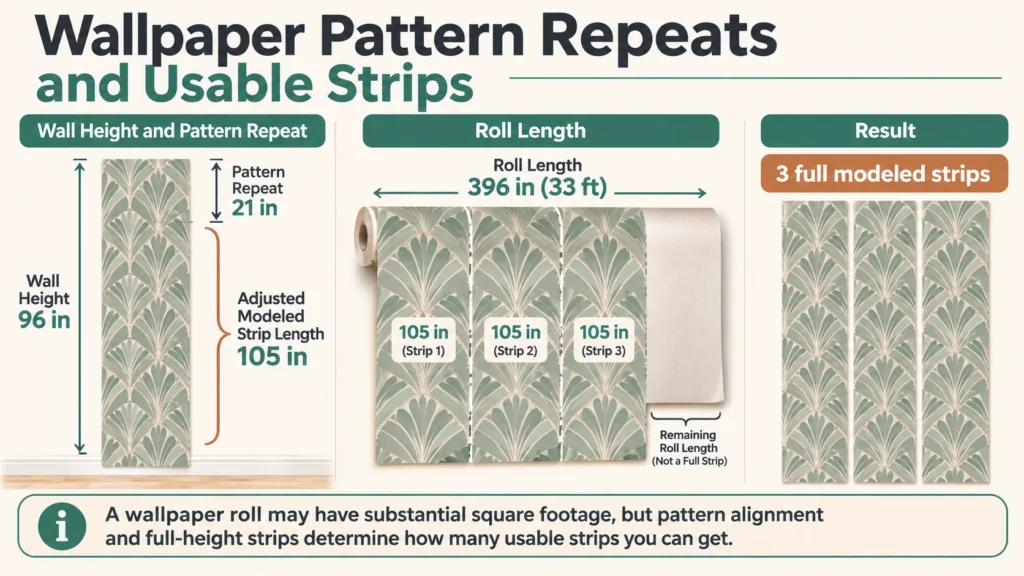
The wallpaper pattern repeat is the vertical distance before the design starts again. How neighboring strips match matters too. Graham & Brown distinguishes three common types:
- Free or random match: adjoining strips do not need a specific vertical offset, so pattern-matching waste is generally lower.
- Straight match: the motif lines up across adjoining edges at the same height; you may need to trim a strip to start at the correct point.
- Offset or half-drop match: neighboring strips begin at different positions in the design. The alternating sequence can create additional waste, and manufacturer instructions should guide the actual cutting plan.
Our calculator models repeating wallpaper by rounding the wall height up to the next complete multiple of the entered vertical repeat. For an 8-ft wall (96 in) and a 21-in repeat, the modeled strip length becomes 5 × 21 = 105 in (8.75 ft). A 33-ft roll is 396 in long, so 396 ÷ 105 permits 3 full modeled strips per roll.
This is a transparent estimating method, not a complete cut diagram. The calculator does not have a separate field for fixed top-and-bottom trimming or alternating half-drop-strip sequences. Increase your planning allowance when the design and wall layout warrant it, and follow the supplier’s specific instructions for complex matches.
Worked example: a 14 × 11 ft room with patterned wallpaper
Assume all four walls are being covered. The room is 14 ft long × 11 ft wide, with 8-ft wall height. The wallpaper is 20.5 in wide × 33 ft long, with a 21-in pattern repeat and an illustrative 10% waste allowance.
- Perimeter: 2 × (14 + 11) = 50 ft = 600 in.
- Full-height strips: round up (600 ÷ 20.5) = 30 strips.
- After a 10% allowance: round up (30 × 1.10) = 33 strips.
- Adjusted strip length: 8 ft = 96 in; round up to the next 21-in repeat = 105 in.
- Strips per 33-ft roll: floor (396 ÷ 105) = 3 strips.
- Rolls needed: round up (33 ÷ 3) = 11 physical rolls of that size.
At an illustrative price of $45 per physical roll, 11 × $45 = $495 in wallpaper. This excludes shipping, primer, paste, installation and other supplies. Use your actual supplier price and confirm whether the listing price refers to the package or a single-roll equivalent.
Why not just divide by square feet? The room has 400 sq ft of gross wall area. If a 21-sq-ft door and 16-sq-ft window are subtracted, 363 sq ft remain. Dividing 363 by 56.4 sq ft gives around 6.4, or seven nominal rolls, but that ignores unusable offcuts and matched strip lengths. The strip-based calculation gives 11 rolls for this example.
The current HomeBuild Metrics tool also displays net wall area if you enter opening area, but it does not reduce the full-height strip count for small openings. Wallpaper may still be needed above and below a door or window.
How much wallpaper do I need for one accent wall?
For a single feature wall, count strips across its width instead of entering an entire room perimeter. For example, take a 10-ft-wide, 9-ft-high accent wall and a 20.5-in × 33-ft roll with no relevant design repeat.
- Wall width = 10 × 12 = 120 in.
- Strips = round up (120 ÷ 20.5) = 6.
- With 10% extra strips = round up (6 × 1.10) = 7.
- A 33-ft roll yields floor (33 ÷ 9) = 3 modeled full-height strips.
- Rolls = round up (7 ÷ 3) = 3 rolls.
This example leaves room for ordinary trimming within each roll, but it still assumes a simple vertical-strip installation. Large motifs, precise centering, custom panels and manufacturer-specific hanging rules can change the answer.
When can you subtract doors and windows?
For paint, subtracting openings from wall area is often useful. Wallpaper is different: a strip may run down the side of a window and need matching pieces above or below it. Removing every window’s square footage from the roll count can underestimate the material.
A large floor-to-ceiling opening, a whole unpapered wall, or a wide section deliberately left bare may truly remove full strips. Calculate the remaining wall runs as separate sections. If a single section has a different height, estimate it separately too.
This is also why a detailed layout matters when centering a bold geometric design or planning a half-drop match. Keeping the motif aligned can be more important than reusing every offcut.
Wallpaper quantity questions homeowners often ask
How many square feet does a double roll cover?
It depends on the product. A 20.5-in × 33-ft York double roll contains about 56.4 sq ft of material, but the usable coverage can be lower after cutting full-height strips, allowing for trimming and matching patterns.
How much extra wallpaper should I buy?
There is no universal percentage. Our calculator uses an adjustable 10% strip allowance by default, but large repeats, complex matches, irregular walls or the need for future repairs can justify additional material. Follow the manufacturer’s guidance where available.
Can I use the calculator for peel-and-stick wallpaper?
Yes, for continuous rolls installed as ordinary full-height vertical strips. Enter the peel-and-stick product’s actual width and length. For wallpaper murals or numbered panels, use the manufacturer’s panel measurements.
Can I estimate wallpaper in metric units?
Yes. Measure room dimensions in meters, roll width and repeat in centimeters, and roll length in meters. A 52-cm-wide × 10-m roll contains 5.2 m² of material before strip-cutting losses.
Should I subtract windows and doors from the number of strips?
Not automatically. You may still need wallpaper above, beside or below an opening. Large openings that remove full strips can be planned as separate remaining wall sections.
Sources and calculation methodology
The numerical examples use basic measured dimensions and the strip-count method implemented by HomeBuild Metrics. These manufacturer and industry references support the guidance on roll packaging and pattern matching:
- York Wallcoverings: Sander Geometric Wallpaper, a double-roll example with documented dimensions and stated pattern match.
- Graham & Brown: How to Measure for Wallpaper, wall measuring and free, straight and offset matches.
- Wallcoverings Association: Understanding Wallcoverings, retail packaging terms and pattern-match definitions.
All counts are material-planning estimates. Actual yield can vary by the product, trimming, wall irregularity, seam placement and print alignment. The $45 roll price is hypothetical, not a current quoted market price.
Estimate wallpaper rolls for your project
Enter your dimensions, roll size, repeat and a planning allowance to estimate the number of rolls and optional cost. Check your supplier’s label and packaging before purchasing.
For other home projects, explore our Home Project Guides.