
CONCRETE & OUTDOORS GUIDE
How Much Concrete Do I Need for a Slab?
For a rectangular slab, concrete volume starts with length × width × thickness. In US units, convert the slab thickness from inches to feet before multiplying, then divide cubic feet by 27 to get cubic yards. In metric, convert thickness from centimeters to meters and calculate directly in cubic metres.
The geometry is simple, but the purchasing quantity also depends on the actual slab thickness, site conditions, your allowance for extra concrete, and, for bagged mix, the yield of the specific product you plan to use.
Start With Volume, Not Just Square Footage
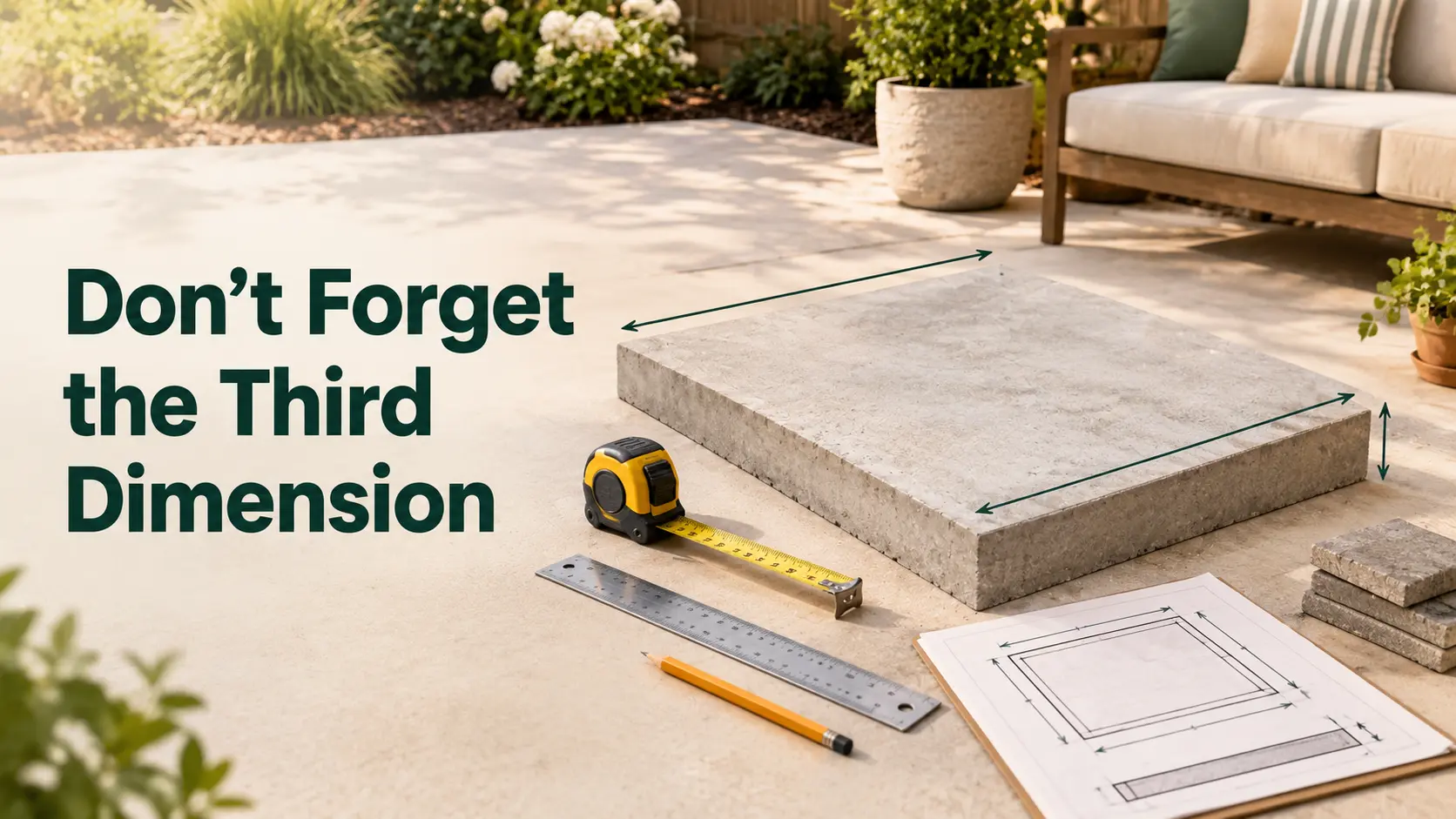
Square footage tells you the size of the slab’s surface. Concrete is purchased by volume, so thickness has to be part of the calculation.
A 10 ft × 10 ft slab has an area of 100 sq ft whether it is 4 inches, 5 inches, or 6 inches thick. The amount of concrete changes each time because the third dimension changes.
Basic slab formula
Concrete volume = length × width × thickness
US calculation
Length (ft) × width (ft) × [thickness (in) ÷ 12] = cubic feet
Cubic feet ÷ 27 = cubic yards
Metric calculation
Length (m) × width (m) × [thickness (cm) ÷ 100] = cubic metres
The unit conversion is important. Multiplying 10 ft × 10 ft × 4 without first converting the 4 inches would mix feet and inches and give the wrong volume.
If you already know your slab dimensions and specified thickness, the HomeBuild Metrics Concrete Calculator handles the unit conversion and returns the slab volume in cubic feet and cubic yards or in cubic metres.
Thickness Can Change the Concrete Order Faster Than You Expect
For a slab with the same length and width, concrete volume changes directly with thickness. That makes an incorrect depth measurement much more significant than it may first appear.
Here is the base volume for the same 10 ft × 10 ft footprint at three example thicknesses, before adding any allowance:
| Example thickness | Cubic feet | Cubic yards |
|---|---|---|
| 4 in | 33.33 cu ft | 1.23 cu yd |
| 5 in | 41.67 cu ft | 1.54 cu yd |
| 6 in | 50.00 cu ft | 1.85 cu yd |
Changing this example from 4 inches to 6 inches increases thickness by 50%, so the required concrete volume also increases by 50%.
These thicknesses are quantity examples, not design recommendations. The required slab thickness depends on the project, loading, ground conditions, local requirements, and the slab design. Use the thickness specified for your project rather than choosing one from a volume table.
Build a Realistic Order by Allowing for Site Conditions
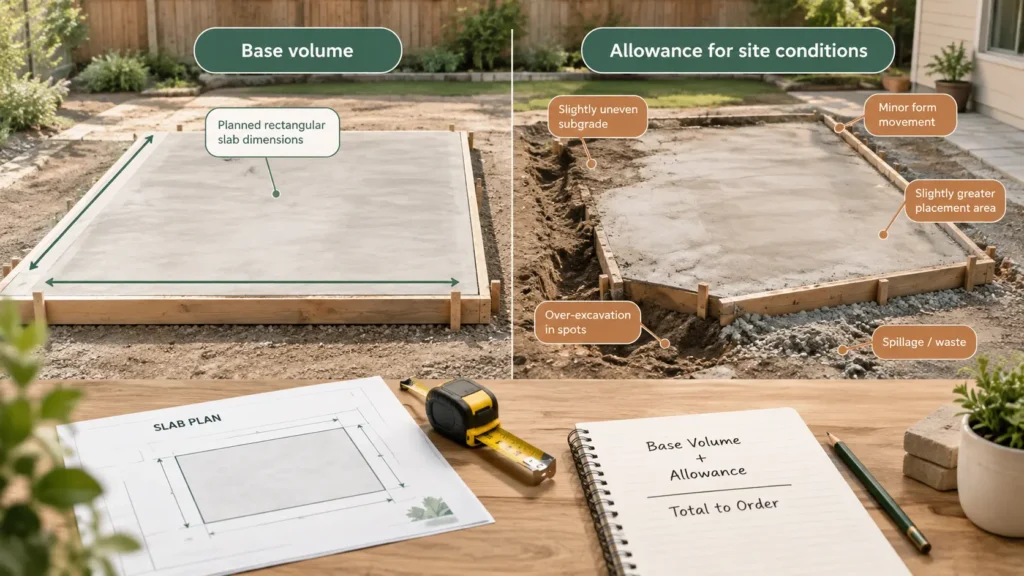
A perfect volume calculation assumes that the forms and subgrade match the planned dimensions exactly and that no material is lost during placement. Real projects can differ.
An allowance can account for conditions such as over-excavation, an uneven subgrade, slightly greater placement dimensions, form movement, spillage, and other contingencies.
The National Ready Mixed Concrete Association recommends allowing roughly 4% to 10% above the volume calculated from plan dimensions for waste, over-excavation, and other contingencies. Heidelberg Materials gives a similar 4–10% rule of thumb. CEMEX’s own customer guidance recommends 10–15% for its ordering context.
Those different recommendations are a good reason not to treat one percentage as a universal rule. A well-controlled slab on a accurately prepared base is not the same situation as a project with irregular excavation or uncertain field dimensions.
Waste-adjusted volume = base slab volume × (1 + allowance percentage)
HomeBuild Metrics leaves this percentage editable so you can choose an allowance that reflects the actual project rather than having one fixed number silently applied to every slab.
One 10 × 10 Slab, Calculated From Dimensions to Bags and Cost
Consider a rectangular slab with these example inputs:
- Length: 10 ft
- Width: 10 ft
- Thickness: 4 in
- Waste allowance: 10%
- Example bag yield: 0.60 cu ft per bag
- Example concrete price: $150 per cubic yard
The 4-inch thickness is an assumption for this calculation example. The $150 per cubic yard figure is also an entered example price, not a current market-price claim.
Convert the thickness before calculating volume
4 in ÷ 12 = 0.3333 ft
10 ft × 10 ft × 0.3333 ft = approximately 33.33 cu ft
Convert cubic feet to cubic yards
33.33 ÷ 27 = approximately 1.23 cu yd
Apply the 10% allowance
33.33 cu ft × 1.10 = approximately 36.67 cu ft
36.67 ÷ 27 = approximately 1.36 cu yd
Convert the required volume to bags
Using the example yield of 0.60 cu ft per bag:
36.67 ÷ 0.60 = approximately 61.11 bags
Bags have to be purchased as whole units, so round upward to 62 bags.
Estimate the concrete material cost
1.3580 cu yd × $150 per cu yd = approximately $203.70
Example result: 33.33 cu ft (1.23 cu yd) before the allowance, approximately 36.67 cu ft (1.36 cu yd) after the 10% allowance, 62 bags at a product yield of 0.60 cu ft per bag, and approximately $203.70 in concrete material at the entered example price.
Metric equivalent: the same slab is approximately 3.048 m × 3.048 m and 10.16 cm thick. Its base volume is about 0.944 m³, increasing to about 1.038 m³ after the same 10% allowance. An equivalent yield of approximately 0.01699 m³ per bag still produces a 62-bag result.
The Concrete Calculator performs these steps using either US or Metric units.
Bag Count Depends on Product Yield, Not Just Bag Weight
If you plan to use bagged concrete, the important purchasing number is the amount of mixed concrete one bag produces. That is the yield per bag.
Bag weight alone should not be treated as a universal yield because concrete mixes can differ by formulation and market. Use the yield stated on the product packaging or technical data for the exact mix you are buying.
As one product-specific example, QUIKRETE Concrete Mix currently lists these approximate yields:
| QUIKRETE Concrete Mix bag | Approximate product yield | Metric equivalent listed by manufacturer |
|---|---|---|
| 40 lb | 0.30 cu ft | 8.5 L |
| 60 lb | 0.45 cu ft | 12.7 L |
| 80 lb | 0.60 cu ft | 17 L |
Those values apply to that product. They should not be copied automatically to every 40 lb, 60 lb, or 80 lb concrete mix.
The bag formula is:
Bags required = waste-adjusted concrete volume ÷ yield per bag
Round the result upward to a whole bag.
Bagged Concrete or Ready-Mix? Calculate the Volume First
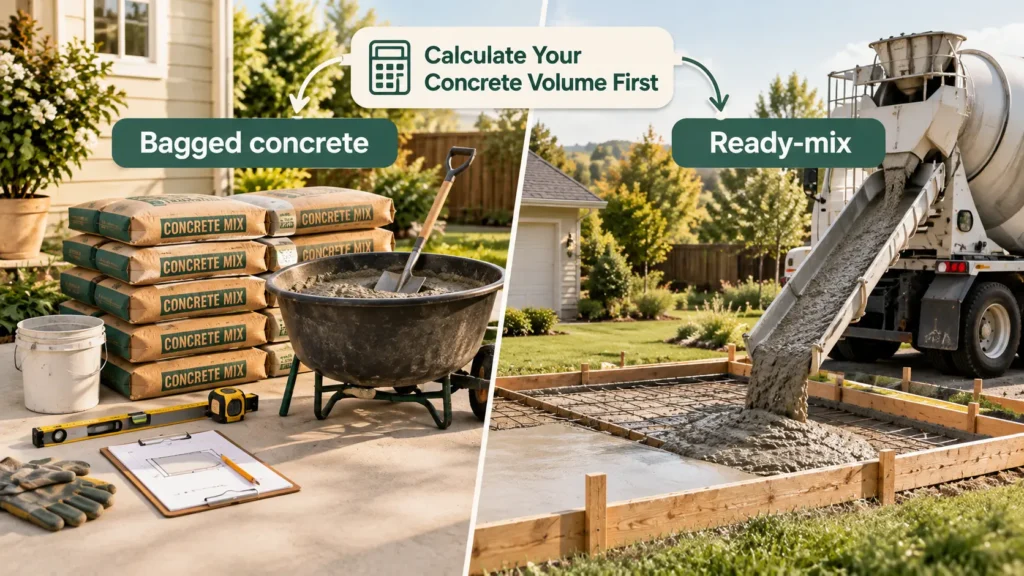
The required slab volume does not change because you switch from bags to ready-mixed concrete. What changes is how that volume is purchased, mixed, delivered, and placed.
Bagged mix can be practical for smaller jobs because material can be purchased in individual bags and mixed as needed. As the required volume grows, the number of bags, mixing time, labor, and ability to place the concrete continuously become increasingly important considerations.
Ready-mix suppliers deliver concrete by volume. Their minimum orders, delivery charges, short-load fees, and ordering increments can vary by company and location, so there is no universal yardage cutoff where every project should switch from bags to a truck.
A practical comparison starts after you know the required concrete volume. Then compare:
- the number of bags your chosen product would require;
- the product yield and bag price;
- the labor and equipment needed to mix and place that quantity;
- local ready-mix minimum orders and delivery charges;
- access for delivery and placement;
- the need to complete the slab placement without unnecessary delay.
The optional cost field in the HomeBuild Metrics calculator is a concrete-material estimate based on the volume and price you enter. It does not include delivery, short-load fees, labor, forms, reinforcement, finishing, pumps, tools, taxes, or site preparation.
Currency is independent from the measurement system. Selecting Metric Units does not require a particular currency, and changing the currency does not perform an exchange-rate conversion.
A Simple Rectangular Formula Can Miss Extra Concrete
The basic slab formula assumes one rectangular area with one consistent thickness. Some real projects contain more concrete than that simple shape.
Examples include:
- thickened slab edges;
- integral or separate footings;
- steps or ramps;
- pads connected to the main slab;
- sections poured at different thicknesses;
- other rectangular or irregular concrete elements attached to the project.
When the design clearly separates into measurable shapes, calculate each section at its actual dimensions and add the volumes together. Apply the appropriate project allowance after you have accounted for the concrete sections that actually exist.
This guide estimates material quantity; it does not design the slab. Structural thickness, footing dimensions, reinforcement, concrete strength, subgrade requirements, drainage, frost protection, and local code requirements may need project-specific design or professional verification.
Check These Numbers Before You Order
A concrete calculation is only as reliable as the dimensions and purchasing inputs behind it. Before buying bags or placing a ready-mix order, confirm the numbers that can materially change the result.
- Length and width: use the actual formed or planned slab dimensions.
- Thickness: use the specified project thickness, not a generic value from an online example.
- Additional concrete sections: include thickened edges, footings, steps, or separate areas where applicable.
- Allowance: choose a percentage that reflects the site and placement conditions rather than assuming one number fits every job.
- Bag yield: if using packaged concrete, copy the yield from the actual product information.
- Ready-mix ordering terms: confirm the local supplier’s minimum order, increments, delivery charges, and other conditions.
- Price unit: use price per cubic yard with US mode or price per cubic metre with Metric mode.
Once those inputs are confirmed, use the HomeBuild Metrics Concrete Calculator to calculate the slab volume, apply your waste allowance, estimate whole bags from the yield you enter, and calculate optional concrete material cost.
Planning another material quantity? Browse the full set of HomeBuild Metrics calculators.