

How Much Mulch Do I Need?
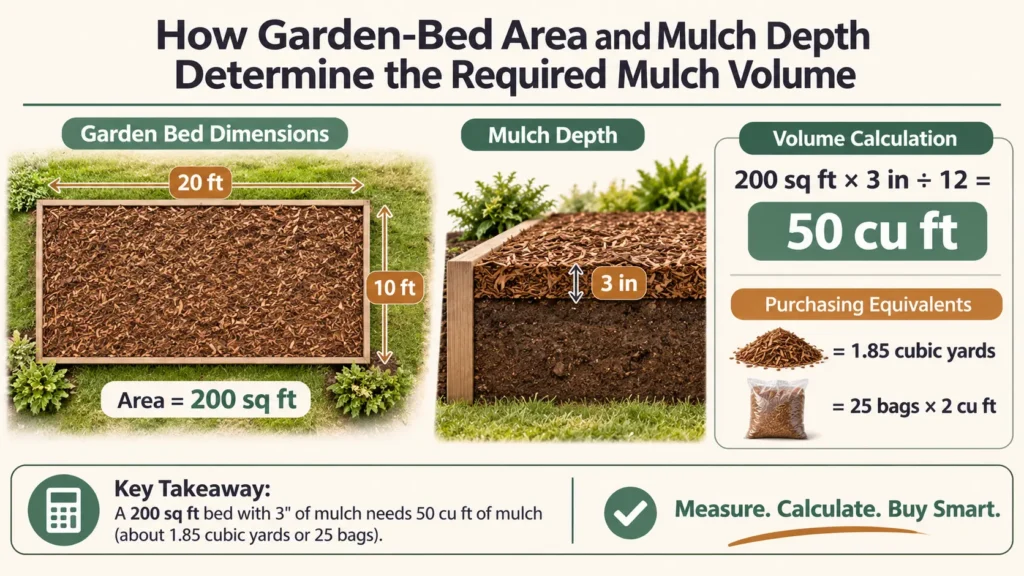
Measure the ground you want to cover, choose the depth, then convert the volume into bags or cubic yards. A fresh 200-square-foot bed at 3 inches deep needs 50 cubic feet of mulch: about 1.85 cubic yards or 25 bags of 2 cubic feet each, before an optional extra allowance.
If you are refreshing a bed that already has mulch, calculate only the missing depth. For other shapes, multiple beds, or price comparisons, use the HomeBuild Metrics Mulch Calculator.
First, measure the ground you will cover
Mulch quantities depend on the surface area of the bed, not the overall size of the yard. Measure the soil you plan to cover and leave out pavement, lawn, patios, and other unmulched sections.
- Rectangular or square beds: length × width = square feet. A 20 ft × 10 ft bed covers 200 sq ft.
- Several beds: calculate each area and add them. If beds have the same shape and size, multiply one bed’s area by the number of beds.
- L-shaped and irregular beds: divide the outline into smaller rectangles or measure the total square footage using a scaled plan.
- Round beds: area = π × radius². For a tree ring with a bare inner circle, subtract the inner circle’s area from the outer circle’s area.
Measure curved borders closely enough for a practical purchase estimate. A surprisingly large difference in total length or width can matter more than a small adjustment to the allowance percentage.
Choose the depth for your mulch and planting conditions
For shredded bark and wood-chip mulch around many landscape beds, 2 to 3 inches is a useful planning range, but it is not a universal instruction. Iowa State University Extension explains that a 2–4-inch range can be appropriate depending on the mulch texture, soil, climate and planting. University of Maryland Extension recommends shallower limits for several mulch materials and cautions against excess depth.
| Planning situation | How to choose the depth |
|---|---|
| New bark or wood-chip mulch in a landscape bed | Begin by checking whether 2–3 in suits the plants, soil and product; adjust using local extension guidance. |
| Existing bed that needs freshening | Measure the mulch already present, then add only enough to reach the target total depth. |
| Tree or shrub bed | Keep mulch shallow and spread it across the root area rather than piling it around the trunk. |
| Fine compost, grass clippings, or other material | Do not use wood-chip depth assumptions. Appropriate layers depend on the material and plant. |
Mulch should not be heaped against trunks, stems or crowns. For trees and shrubs, keep the root flare visible and leave a gap around the bark. Excessively deep mulch can hold moisture against plants and reduce soil aeration. Maryland Extension documents these problems.
From square feet to cubic yards: the mulch formula
In US measurements, convert the intended mulch depth from inches to feet, multiply by your bed area, then divide cubic feet by 27 to get cubic yards.
Mulch volume formulas
Cubic feet = area (sq ft) × new mulch depth (in) ÷ 12
Cubic yards = area (sq ft) × new mulch depth (in) ÷ 324
Whole bags = round up [required cubic feet ÷ cubic feet per bag]
If adding a material allowance, multiply the calculated volume by (1 + allowance percentage ÷ 100) before rounding up bags. The allowance is optional, not a universal requirement.
Worked example: 200 square feet at 3 inches
- Area: 20 ft × 10 ft = 200 sq ft.
- Depth: 3 in ÷ 12 = 0.25 ft.
- Volume: 200 × 0.25 = 50 cu ft.
- Bulk mulch: 50 ÷ 27 = 1.85 cu yd (rounded).
- Two-cubic-foot bags: 50 ÷ 2 = 25 bags.
If you choose a 10% planning allowance, 50 × 1.10 = 55 cu ft. That becomes about 2.04 cubic yards or 28 two-cubic-foot bags. This example assumes the entire bed needs a new 3-inch layer and does not already contain usable mulch.
Mulch coverage chart for common bed sizes
The following estimates assume a uniform 3-inch new layer, with no existing mulch and no extra allowance. The bag counts are rounded up to whole 2-cu-ft bags; cubic yards are shown to two decimal places.
| Bed area (sq ft) | Mulch (cu ft) | Bulk volume (cu yd) | 2-cu-ft bags |
|---|---|---|---|
| 50 | 12.5 | 0.46 | 7 |
| 100 | 25 | 0.93 | 13 |
| 150 | 37.5 | 1.39 | 19 |
| 200 | 50 | 1.85 | 25 |
| 300 | 75 | 2.78 | 38 |
| 500 | 125 | 4.63 | 63 |
| 1000 | 250 | 9.26 | 125 |
How much ground will one bag cover?
These are geometric coverage figures for stated bag volumes. They do not account for uneven ground, settling, or an optional material allowance.
| New mulch depth | 1.5-cu-ft bag | 2-cu-ft bag | 3-cu-ft bag |
|---|---|---|---|
| 2 in | 9 sq ft | 12 sq ft | 18 sq ft |
| 3 in | 6 sq ft | 8 sq ft | 12 sq ft |
| 4 in | 4.5 sq ft | 6 sq ft | 9 sq ft |
Check the package label before buying. Bags are sold by volume; do not substitute bag weight for cubic feet unless the manufacturer provides an appropriate conversion.
Refreshing last year’s mulch? Subtract what remains
The main reason people overorder mulch is treating an existing bed as if it were bare. Before purchasing, gently rake the old mulch, check the depth in several spots and estimate how much more is genuinely needed.
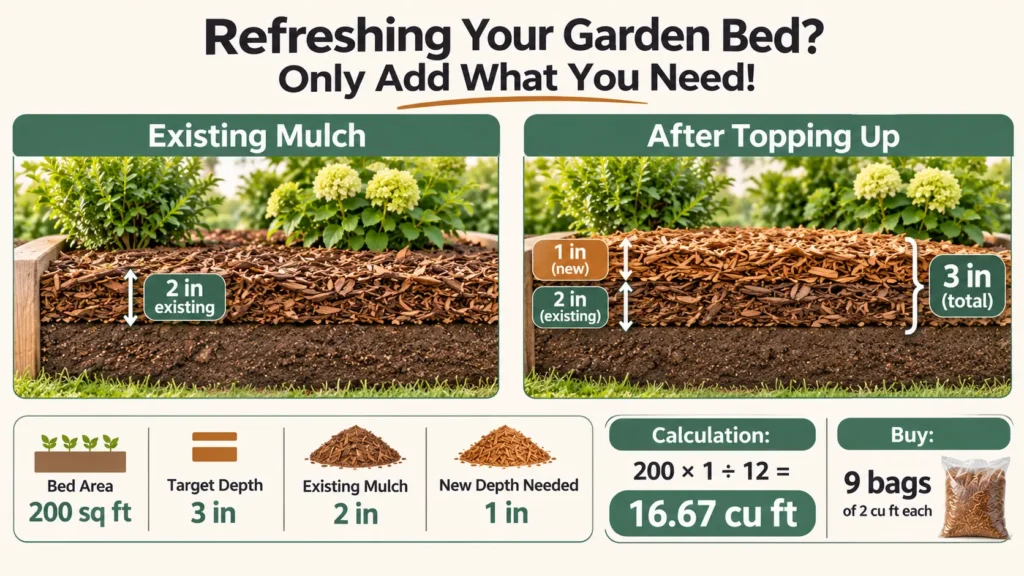
New depth to add = max(0, target total depth − existing mulch depth). The target refers to the final combined layer of old and new mulch, not the thickness of a fresh layer placed on top.
Top-up example: an existing 2-inch layer
Suppose a 200-sq-ft bed already has roughly 2 inches of usable mulch and you want a combined 3-inch layer. Add only 1 inch:
- New mulch volume = 200 × 1 ÷ 12 = 16.67 cu ft.
- Bulk volume = 16.67 ÷ 27 = 0.62 cu yd.
- Bagged mulch = round up (16.67 ÷ 2) = 9 two-cu-ft bags.
- With an optional 10% allowance, 16.67 × 1.10 ≈ 18.33 cu ft, or 10 bags.
If existing mulch already reaches your intended depth, another layer is usually unnecessary. This also aligns with University of Maryland Extension advice to supplement only as needed rather than adding a thick new layer every year.
For tree rings, subtract the unmulched center
A circular tree bed is different from a solid circle if you leave a bare space near the trunk. Calculate the outer circle, subtract the inner circle and use that ring area for the mulch volume.
Ring area = π × (outer diameter² − inner diameter²) ÷ 4. Both diameters must use the same units.
Example: an 8-foot ring with a 2-foot bare center
- Area = π × (8² − 2²) ÷ 4 = 47.12 sq ft.
- At 3 inches deep, volume = 47.12 × 3 ÷ 12 ≈ 11.78 cu ft.
- Bulk volume ≈ 0.44 cu yd; 2-cu-ft bags = 6 bags without extra allowance.
The 2-foot inner diameter is an example measurement, not a rule for every tree. Follow species- and site-appropriate guidance for how far mulch extends over the root zone, and never pile mulch against the trunk. University of Maryland Extension recommends an exposed trunk and a wide, shallow mulched area.
Bags or bulk mulch: compare the final purchase, not just the price tag
For a few small planting beds, bags can be easier to transport and spread. For larger areas, bulk delivery may be convenient. Compare prices in matching units and include delivery fees, minimum orders and any quantity increments the supplier requires.
For the earlier 200-sq-ft, 3-inch example with a 10% allowance, the estimate is 55 cu ft: 28 bags of 2 cu ft or about 2.04 cu yd. Here is a hypothetical price comparison, not a current store quote:
| Option | Illustrative unit price | Estimated material-only cost |
|---|---|---|
| 28 bags (2 cu ft each) | $4.50 per bag | $126.00 |
| 2.04 cu yd in bulk | $50.00 per cu yd | About $101.85 |
The bulk figure uses the unrounded 55 ÷ 27 = 2.0370 cubic yards, multiplied by $50. Suppliers may sell only in particular increments or require a larger minimum order, changing the checkout total. Neither example includes tax, delivery, unloading, labor or equipment.
The Mulch Calculator lets you enter a bag price and a bulk price in your selected currency. Its currency selector labels your entered prices; it does not fetch exchange rates or convert money automatically.
Calculating mulch in square meters and liters
Metric estimating follows the same area × depth principle. Convert centimeters to meters before multiplying:
Cubic meters = area (m²) × new depth (cm) ÷ 100. One cubic meter contains 1,000 liters.
For example, a 20 m² bed needing 5 cm of new mulch requires 20 × 5 ÷ 100 = 1.00 m³, or 1,000 liters. That equals 20 bags of 50 liters, before any optional allowance. With a 10% allowance, it becomes 1.10 m³ or 22 bags.
A 5-cm layer is about 2 inches. The appropriate depth still depends on mulch material, plants and soil; changing the measurement system does not change the horticultural recommendation.
Five checks before you buy or spread mulch
- Confirm the actual bag size. A bag marked 1.5 cu ft, 2 cu ft, 3 cu ft, 40 L or 50 L contains a different volume. Match the calculator setting to the product.
- Check existing depth in several places. Older mulch may be uneven. Rake it level first; do not automatically add another full layer.
- Keep mulch away from trunks and plant crowns. Make broad, level rings rather than “mulch volcanoes,” and leave the root flare exposed.
- Remove established weeds first. Mulch suppresses many new weeds but does not reliably kill perennial weeds already growing. Iowa State Extension discusses how to prepare and manage mulched beds.
- Ask how the supplier sells bulk material. Confirm cubic-yard increments, delivery minimums, driveway access and whether the stated volume is nominal or measured.
The calculation estimates mulch material volume. It does not include edging, weed removal, landscape fabric, delivery or labor. If you are switching to stone instead of organic mulch, use a material-specific estimate such as our Gravel Calculator; stone weight and delivery are not the same as bark mulch.
Questions homeowners often ask
How many square feet does one cubic yard of mulch cover?
One cubic yard contains 27 cubic feet. Spread uniformly, it covers 162 sq ft at 2 inches, 108 sq ft at 3 inches or 81 sq ft at 4 inches, before any extra allowance.
How many bags of mulch do I need for 1,000 square feet?
At 3 inches deep with no existing mulch, 1,000 sq ft requires 250 cu ft, which is 125 two-cu-ft bags or approximately 9.26 cubic yards. Adjust the depth and allowance to fit the actual project.
Should I always add 10% extra mulch?
No. An allowance is optional. You may choose a buffer for measurement uncertainty or irregular spreading, but use a smaller allowance or zero when the area and depth are well established. Our calculator starts with 10%, which you can change.
Can I use the same volume calculation for pine straw or compost?
Volume still equals area × depth, but depth recommendations and sales units differ by material. Pine straw is often sold by bale rather than cubic feet, and a bale’s coverage varies by product. Compost is generally applied at a different depth from bark mulch. Follow the product label or local extension guidance for that material.
Method and sources
All calculations in this guide use geometric volume, not a weight-to-volume conversion. The tables assume level coverage at the stated depth, and the hypothetical pricing example is not a market-price claim.
- Iowa State University Extension — How to Determine the Amount of Mulch Needed for a Garden Bed. Area, cubic-foot, bag and cubic-yard calculations.
- Iowa State University Extension — Using Mulch in the Garden. Mulch types, depth selection, weed management and application.
- University of Maryland Extension — Mulching Trees and Shrubs. Plant-specific applications, mulch depth and trunk clearance.
- University of Maryland Extension — Excess Mulch Problems. Why overmulching and repeated full-depth applications can harm plants.
Calculate the mulch for your own garden bed
Enter your bed shape, measurements, target depth, existing mulch, bag size and optional prices. The calculator gives both bulk volume and whole-bag estimates without making you redo the math.