
FLOORS & TILE GUIDE
How Many Boxes of Flooring Do I Need?
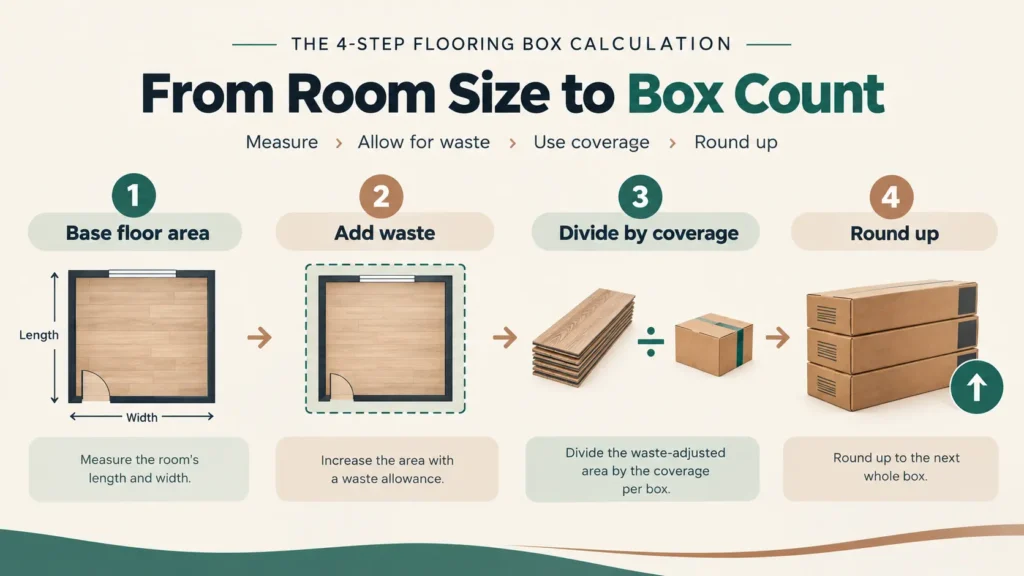
To calculate how many boxes of flooring you need, find the total floor area, add your waste allowance, divide by the exact coverage per box, and round the result up to the next whole box.
The box coverage matters just as much as the room size. A 180 sq ft project can require a different number of cartons depending on whether the flooring covers 18, 22.5, or 30 sq ft per box. Use the coverage stated for the exact flooring product you plan to buy rather than a generic average.
How to Calculate the Number of Flooring Boxes
For flooring sold in cartons with a stated coverage per box, the calculation has four main steps.
1. Base floor area
Length × width
2. Flooring required with waste
Base area × (1 + waste percentage)
3. Boxes required
Flooring required ÷ coverage per box
4. Purchase quantity
Round the box result upward to the next whole carton
For example, if the calculation gives 8.1, 8.8, or 8.99 boxes, the practical purchase quantity is 9 boxes. Rounding down would leave the project short of the calculated flooring requirement.
If you already know your room dimensions, waste allowance, and package coverage, you can enter them directly in the HomeBuild Metrics Flooring Calculator. It supports US and Metric units and can also estimate material cost when you enter a price.
Worked Example: From Room Size to Flooring Boxes
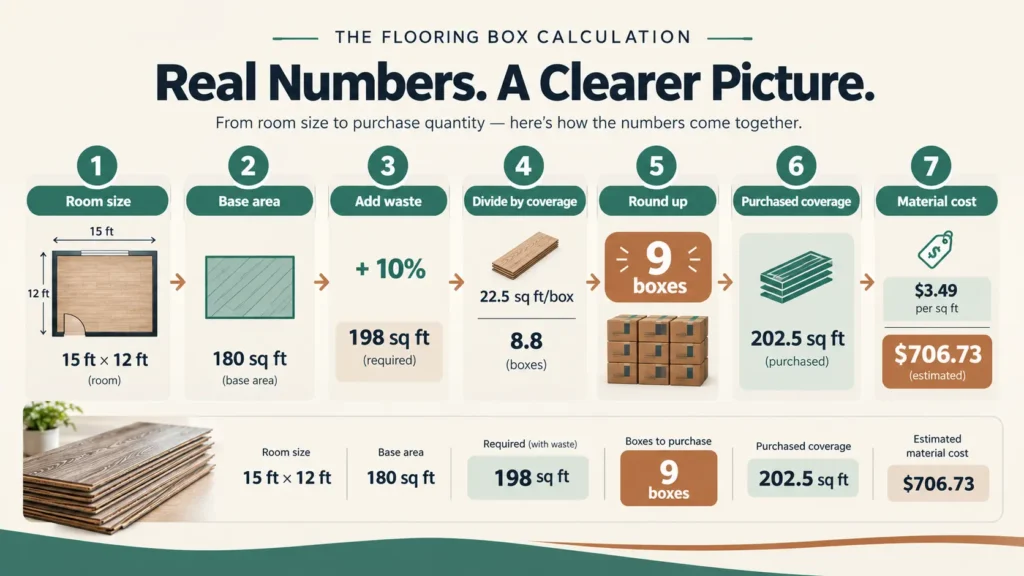
Suppose you are planning flooring for a rectangular room with these inputs:
- Room length: 15 ft
- Room width: 12 ft
- Waste allowance: 10%
- Coverage per box: 22.5 sq ft
- Material price: $3.49 per sq ft
1. Calculate the base floor area
15 ft × 12 ft = 180 sq ft
2. Add the 10% waste allowance
180 sq ft × 1.10 = 198 sq ft of flooring required
3. Divide by the coverage per box
198 sq ft ÷ 22.5 sq ft per box = 8.8 boxes
4. Round up to the purchase quantity
You cannot cover the calculated area with 8.8 physical cartons, so round upward:
9 boxes required
5. Calculate the coverage you will actually purchase
9 boxes × 22.5 sq ft = 202.5 sq ft of purchased coverage
6. Estimate the material cost
202.5 sq ft × $3.49 = $706.725, which rounds to $706.73.
Result: The 180 sq ft room needs 198 sq ft after the 10% allowance. With 22.5 sq ft per box, the purchase becomes 9 boxes, providing 202.5 sq ft of flooring. At $3.49 per sq ft, the estimated flooring material cost is $706.73.
Metric equivalent: the room is approximately 4.572 m × 3.6576 m, or about 16.72 m². A carton covering 22.5 sq ft is approximately 2.09 m². After the same 10% waste allowance, about 18.39 m² is required, which still rounds to 9 cartons.
The units change, but the purchasing logic does not: calculate the area, add the allowance, divide by the package coverage, and round upward.
Why Coverage per Box Matters
There is no reliable universal answer to “How many square feet are in a box of flooring?” Package coverage varies by product. The value you need is the coverage of the exact carton, pack, or bundle you are buying.
Look for wording such as:
- sq ft per carton
- sq ft per box
- m² per pack
- coverage per package
You can usually find this on the product page, specification sheet, shelf label, or packaging. Lowe’s flooring planning guidance, for example, tells buyers to use the square-foot coverage shown on the individual carton because package coverage can vary by product.
Do not replace a stated value such as 22.45 sq ft or 2.08 m² with a convenient round number. Small differences can be enough to push a project into another box once the final result is rounded upward.
Not every flooring product is sold in fixed-coverage boxes. Some unfinished hardwood is sold in variable-size bundles whose square-foot coverage can change from bundle to bundle. If the retailer or manufacturer uses that kind of packaging, follow its ordering method rather than forcing the product into a fixed-carton formula.
How Much Waste Should You Add?
A waste allowance gives you additional flooring for cuts, offcuts, layout requirements, damaged pieces, and other installation losses. There is no single percentage that is correct for every floor.
Ten percent is a common planning figure for straightforward flooring projects, but current manufacturer guidance varies. Bruce recommends 5% extra for standard hardwood layouts and 10% for diagonal layouts. Kährs recommends about 5% generally and around 7–10% for more complex layouts such as herringbone or stairs. Some Shaw and COREtec product calculators automatically add 15% for installation errors or other unforeseen circumstances.
| Project condition | Waste planning approach |
|---|---|
| Simple rectangular room with a straightforward plank layout | Follow the product guidance; roughly 5–10% appears in current manufacturer recommendations. |
| Diagonal, patterned, stair, or more complex installation | A higher allowance may be appropriate because the layout creates more cuts and unusable offcuts. |
| Irregular room with many corners or transitions | Consider the extra cuts rather than relying only on total square footage. |
| Manufacturer specifies its own allowance | Use the product-specific requirement instead of a generic percentage. |
The waste percentage in the HomeBuild Metrics calculator is intentionally user-entered. That allows you to use the allowance appropriate for your flooring, layout, and installation rather than having one hidden percentage applied to every project.
How to Measure Irregular Rooms and Multiple Areas
The basic length × width formula works directly for rectangles. An L-shaped room, connected closet, alcove, hallway, or multi-room project usually needs to be divided into simpler sections first.
For an irregular space:
- Sketch the floor and divide it into rectangles or other simple measurable sections.
- Measure the length and width of each rectangular section.
- Calculate each section separately.
- Add the section areas together.
- Apply the waste allowance to the combined area.
- Divide by the product’s coverage per box and round upward.
Lowe’s recommends the same general approach for irregular rooms: divide the space into smaller sections, calculate each area, and combine the results.
Include closets, nooks, hallways, or adjoining spaces if the new flooring will continue through them. Do not count areas that will not receive the flooring simply because they fall inside the room’s overall outline.
If several separate rooms will use the same flooring, calculate the combined installation area before determining the final order. That gives you a project-level quantity rather than independently rounding every small space unless the rooms genuinely require separate orders.
Why Whole-Box Rounding Changes the Result
The waste-adjusted flooring area and the amount you physically purchase are not always the same number.
In the worked example, the project requires 198 sq ft after waste. But cartons cover 22.5 sq ft each:
198 ÷ 22.5 = 8.8 boxes
Because 8 boxes would provide only 180 sq ft, the order must become 9 boxes. Those 9 boxes contain:
9 × 22.5 = 202.5 sq ft
Required coverage: 198 sq ft
Purchased coverage: 202.5 sq ft
Extra created by box rounding: 4.5 sq ft
That extra 4.5 sq ft was not created by increasing the waste percentage. It exists because the flooring is packaged in whole cartons.
This distinction matters when deciding whether to buy another box for future repairs. First check how much usable flooring your rounded order already provides.
How to Estimate Flooring Material Cost
If you know the price per square foot or square metre, you can also estimate the flooring material cost.
When box coverage is supplied, the useful purchasing formula is:
Purchased coverage = number of full boxes × coverage per box
Estimated flooring material cost = purchased coverage × price per area unit
Using purchased coverage matters because you pay for the material contained in the full cartons you buy, not just the exact theoretical area needed after waste.
In the example:
202.5 sq ft × $3.49 per sq ft = $706.73
This is a flooring material estimate. It does not automatically include labor, underlayment, moisture barriers, adhesives, fasteners, transitions, trim, subfloor repairs, delivery, taxes, tools, or other project costs.
The HomeBuild Metrics Flooring Calculator lets you choose a currency and enter your local price per square foot or square metre. The currency selector formats the cost you enter; it does not perform live exchange-rate conversion.
Should You Buy an Extra Box for Future Repairs?
Keeping matching flooring can be useful if a damaged plank needs to be replaced years later. Colors may be discontinued, locking systems can change, and later production runs may not look exactly like the material installed today.
That does not mean every project automatically needs one additional unopened carton beyond the calculated order.
First look at:
- how much flooring remains after installation;
- how much extra coverage was created by whole-box rounding;
- whether the product is likely to remain available;
- whether later batches may be difficult to match;
- the cost and storage space required for another carton;
- any manufacturer or installer recommendation.
Bruce, for example, recommends keeping unused hardwood for future repairs and suggests keeping an unopened carton when practical.
If your rounded box count already leaves several full usable planks, that stock may be enough for your situation. If the flooring is unusual, discontinued, highly variable, or difficult to source, retaining more original material may be more valuable.
Common Flooring Box Calculation Mistakes
Using a generic coverage per box
Flooring cartons do not all contain the same area. Use the coverage stated for your exact product rather than assuming a typical box size.
Calculating the room area but forgetting waste
The measured floor area is not necessarily the amount of material that should be ordered. Cuts, layout, and installation losses need to be considered before the box count is calculated.
Rounding the box count down
If the calculation says 7.2 boxes, buying 7 boxes does not provide the calculated coverage. Round the quantity upward to 8.
Ignoring closets, alcoves, or connected spaces
If those areas will receive the same flooring, include them in the total project area rather than measuring only the main rectangle.
Confusing required coverage with purchased coverage
The waste-adjusted requirement may be 198 sq ft while the physical cartons contain 202.5 sq ft. The second number is what you actually buy and, when pricing by area, what determines the material cost.
Adding extra material twice without checking
A waste allowance and whole-box rounding can already create additional flooring. Check the amount you will physically receive before automatically adding another full carton for spare stock.
Forcing every flooring product into a box formula
If the product is sold in variable-size bundles or through another ordering system, use the seller’s stated purchasing method instead of assuming fixed coverage per carton.
Frequently Asked Questions
How many boxes of flooring do I need for a 12 × 12 room?
A 12 ft × 12 ft room has a base area of 144 sq ft, but the box count cannot be determined from room size alone. You still need the waste allowance and the exact square-foot coverage per box. Add the waste allowance to 144 sq ft, divide by the stated box coverage, and round the result upward.
Where do I find the square feet or square metres per box?
Check the product page, specification sheet, carton label, or retailer information for the exact flooring. Look for terms such as “sq ft per carton,” “coverage per box,” or “m² per pack.” Do not assume that another product from the same brand has the same package coverage.
Does 10% waste mean I need 10% more boxes?
Not necessarily. The 10% is added to the required flooring area first. That area is then divided by the coverage per box and rounded upward. Depending on the carton size, adding 10% area may or may not increase the final box count by exactly 10%.
Can I calculate flooring boxes in square metres?
Yes. Use the same method with consistent metric units: calculate the floor area in m², add the waste allowance, divide by the m² supplied per pack, and round upward. The HomeBuild Metrics Flooring Calculator has a Metric Units option for this.
Calculate Your Flooring Boxes and Cost
For the most useful estimate, measure the full installation area, choose a waste allowance that fits the flooring and layout, and use the exact package coverage printed for the product you plan to buy.
The HomeBuild Metrics Flooring Calculator can then calculate the required flooring area, round the order to whole boxes, show the actual purchased coverage, and estimate material cost using US or Metric units.
Calculate how many boxes of flooring you need →
You can also browse the full collection of HomeBuild Metrics calculators for other home-project planning tasks.