
FLOORS & TILE GUIDE
How Much Extra Tile Should I Buy?
For a straightforward tile project, about 10% extra is a common planning starting point—but it is not a universal rule. A simple layout may sometimes justify 5–10%, while herringbone, complex patterns, irregular spaces, difficult cuts, or product-specific requirements can push the allowance to 15–20% or more.
The right percentage depends on what happens to the tile after you measure the room: cuts, unusable offcuts, breakage, pattern geometry, product variation, box quantities, and any matching tile you want to keep for future repairs.
How Much Extra Tile Should You Buy? The Quick Answer
There is no single waste percentage that fits every tile job. Manufacturers themselves give different recommendations: Motawi specifies 5–10% overage for its tile, while Fireclay recommends a minimum of 15% for its standard patterns and at least 20% for complex layouts such as herringbone and chevron. That is why a percentage should be treated as a project-specific planning allowance, not a fixed industry rule.
| Project condition | Planning starting point | What to consider |
|---|---|---|
| Very simple straight layout | 5–10% | The lower end is most defensible when measurements and cuts are predictable and the manufacturer, supplier, or installer supports a low allowance. |
| Typical straightforward layout | Around 10% | A common starting point for cuts, minor breakage, and normal installation loss. |
| More cuts, irregular geometry, diagonal layout, or difficult room | Around 10–15% or more | Extra corners, angled cuts, obstacles, and fewer reusable offcuts can increase material loss. |
| Herringbone, chevron, or another cut-heavy pattern | About 15–20% or manufacturer guidance | Pattern geometry can produce more angled perimeter cuts and unusable pieces. |
| Highly variable, handmade, natural, fragile, or difficult-to-match material | Manufacturer-specific; sometimes above 20% | Selection, breakage risk, appearance variation, and future matching may require considerably more stock. |
Use the product guidance first. A general 10% or 15% planning figure should not override a tile manufacturer’s stated overage requirement. Handmade tile, natural stone, specialty shapes, and pattern-specific products may have very different ordering recommendations.
Once you have chosen a reasonable allowance, enter it in the HomeBuild Metrics Tile Calculator. It can calculate the project area, apply your waste percentage, round the result to whole tiles, and—if you enter tiles per box—round the purchase up to whole boxes.
What Changes Your Tile Waste Allowance?
The measured floor or wall area is only the starting point. The amount of extra tile you need depends heavily on how efficiently those tiles can actually be laid and cut.
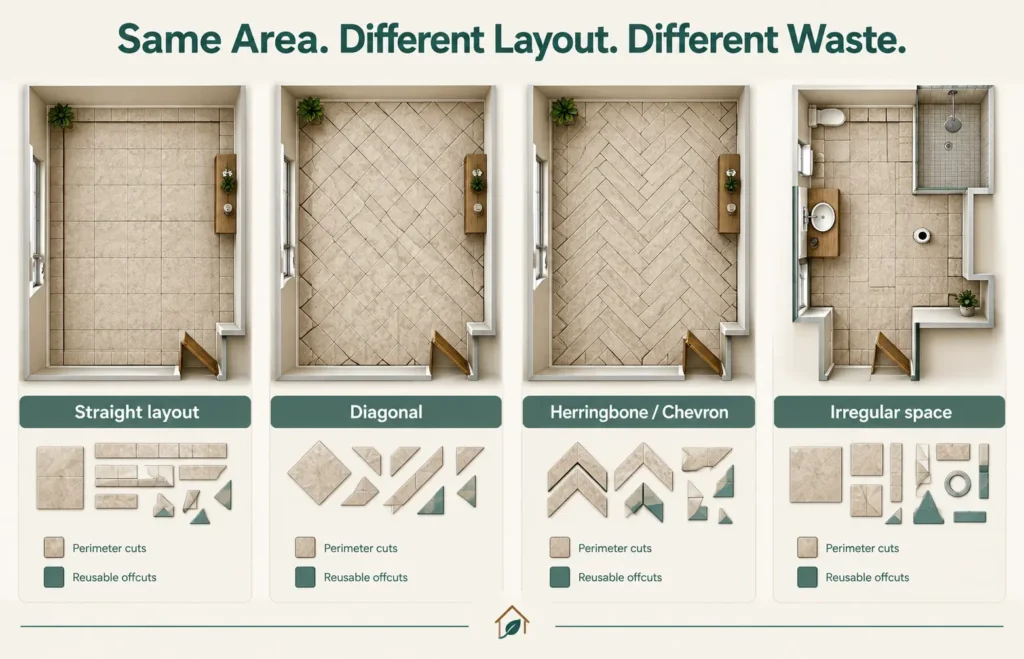
Straight layouts usually create the simplest cuts
A straight grid or uncomplicated running layout in a rectangular space generally gives you the best chance of reusing offcuts. Cuts are concentrated around the perimeter, and a piece cut from one end of a row may sometimes work elsewhere.
That is where lower allowances are most plausible. Motawi, for example, tells customers buying its made-to-order tile to order 5–10% extra for breakage and range selection. Bedrosians also uses 10% as a waste-and-reserve option on many of its tile product pages. These are useful reference points, but they are not universal requirements for every brand or project.
Diagonal, herringbone, and other patterns can need more
Turning a layout or creating an interlocking pattern changes the cuts at walls and edges. More pieces may have to be cut at angles, and the offcut left behind may be harder—or impossible—to reuse somewhere else.
This is why patterned layouts commonly move toward the higher end of the range. In its current backsplash guidance, Bedrosians estimates roughly 15–20% waste for herringbone compared with about 10% for running bond. Fireclay recommends at least 20% overage for complex layouts such as herringbone and chevron for its own products.
A diagonal layout does not automatically mean that exactly 15% is correct. Room dimensions, tile dimensions, the starting position, and whether cut pieces can be reused all matter. Treat the pattern as a reason to examine the layout more carefully rather than as permission to apply a fixed number without thinking.
Irregular rooms and obstacles create more cut edges
An open rectangular floor is very different from a bathroom with several corners, a doorway, a shower curb, pipe penetrations, niches, or an angled wall. Two projects can have the same total area but require different amounts of tile because one produces many more individual cuts.
If your project has several short wall sections or obstacles, consider moving upward from the allowance you would use for a simple rectangle. The important question is not just “How large is the room?” but “How many cuts will this layout create, and how reusable will the offcuts be?”
Large-format tile can make each mistake more expensive
Large-format tile does not automatically require a fixed higher waste percentage. A well-planned large-tile layout in a simple room may be efficient. But one unusable or incorrectly cut large tile represents much more material than one small tile, and room dimensions can leave large offcuts that are difficult to reuse.
Look at the actual layout rather than increasing the percentage simply because the tile is large. Product-specific instructions matter here too: some natural-stone suppliers recommend larger selection allowances for bigger pieces when color and veining need to be blended across the installation.
Natural, handmade, fragile, or highly variable tile needs product-specific thinking
Not every extra tile is destined to become a cut-off. Some materials vary enough that the installer may need additional pieces to create a balanced finished appearance, and some made-to-order products can be difficult to match with a later order.
For example, Fireclay bases its higher overage guidance partly on cuts, waste, and potential breakage. Clé’s guidance for certain natural-stone products recommends at least 15% overage and may recommend 25–35% when substantial color, shade, and veining selection is desired.
That does not mean every natural-stone project needs 35%. It shows why a generic percentage should never replace the guidance for the actual material you are buying.
DIY difficulty can justify more caution—but not an invented “beginner percentage”
If the project involves unfamiliar cuts, drilling, several penetrations, or an intricate layout, there are more opportunities to lose a piece during installation. That may justify a larger cushion, but there is no universal percentage that every DIY installer should add simply for being a beginner.
Consider the actual cuts you expect to make, the replacement cost of a damaged piece, and whether more matching material will still be available if you run short.
How to Calculate Extra Tile
Once you have selected an appropriate waste allowance, the arithmetic is straightforward. Keep all measurements in a consistent unit system.
1. Project area
Length × width
2. Tile area
Tile length × tile width
3. Tiles before waste
Project area ÷ tile area
4. Tiles to buy
Tiles before waste × (1 + waste percentage), then round up to a whole tile
5. Boxes required, if tiles per box are known
Tiles to buy ÷ tiles per box, then round up to a whole box
For US units, you might measure the project in feet and the tile in inches; the tile dimensions must be converted so the areas are comparable. In metric, a project measured in meters and a tile measured in centimeters requires the same kind of unit consistency.
The HomeBuild Metrics calculator handles those unit conversions for you. US Units are the default, and you can switch to Metric Units on the same page.
Worked Example: What 5%, 10%, 15%, and 20% Actually Change
Consider a rectangular project using these inputs:
- Project: 12 ft × 10 ft
- Tile: 12 in × 12 in
- Tiles per box: 10
Step 1: Calculate the project area.
12 ft × 10 ft = 120 sq ft
Step 2: Calculate the tile area.
A 12 in × 12 in tile is 1 ft × 1 ft, so each tile covers 1 sq ft.
Step 3: Calculate the base tile count.
120 sq ft ÷ 1 sq ft per tile = 120 tiles before waste.
Now compare several waste allowances:
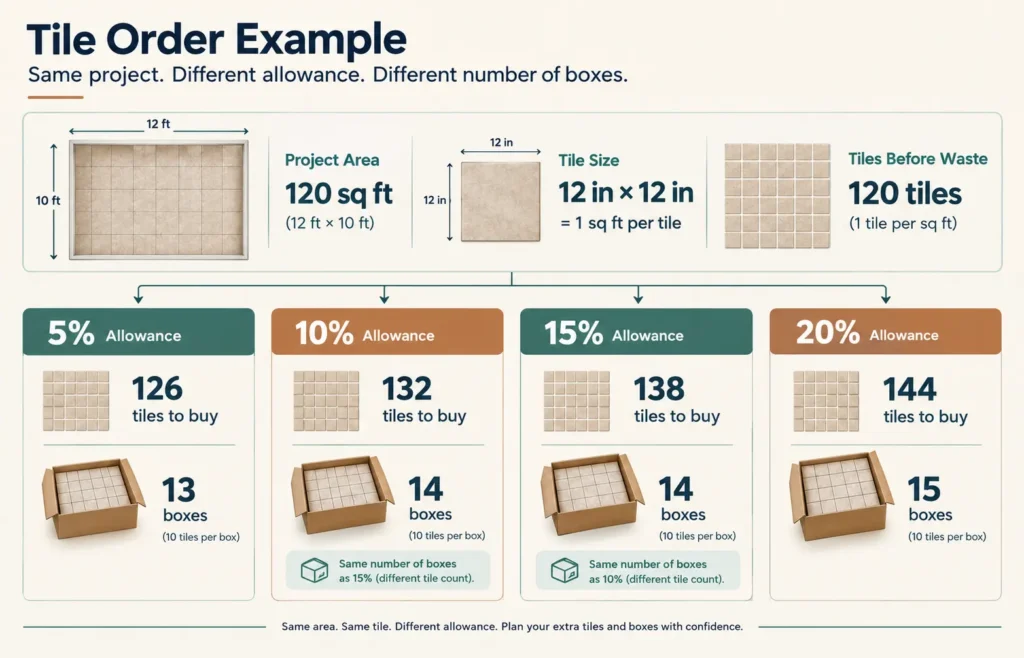
| Waste allowance | Calculation | Tiles to buy | Boxes at 10 tiles per box |
|---|---|---|---|
| 5% | 120 × 1.05 = 126 | 126 | 13 |
| 10% | 120 × 1.10 = 132 | 132 | 14 |
| 15% | 120 × 1.15 = 138 | 138 | 14 |
| 20% | 120 × 1.20 = 144 | 144 | 15 |
At 10% waste, the calculation gives 132 tiles. Dividing by 10 tiles per box gives 13.2 boxes, so the purchase must be rounded up to 14 boxes.
The table also shows why box rounding matters. A 10% allowance requires 132 tiles and a 15% allowance requires 138 tiles, but both still require 14 boxes. If each box contains 10 tiles, you physically purchase 140 tiles either way.
That does not make 10% and 15% the same planning allowance. With 10%, the 14-box order contains eight tiles beyond the calculated 132-tile requirement. With 15%, it contains only two beyond the calculated 138-tile requirement. Packaging can create additional material, but it does not change the reasoning behind the waste percentage.
The same example in metric: 12 ft × 10 ft converts to approximately 3.6576 m × 3.048 m, and a 12 in × 12 in tile converts to 30.48 cm × 30.48 cm. The project is approximately 11.1484 m² and each tile is 0.09290304 m², which still gives 120 base tiles. A 10% allowance therefore still gives 132 tiles and 14 boxes.
Installation Waste Is Not the Same as Spare Tile
It helps to separate three quantities that are often combined under the word “waste.”
- Installation allowance: material available for cuts, unusable offcuts, breakage, and mistakes during the job.
- Box-rounding surplus: extra pieces you receive because the required quantity does not divide evenly into whole boxes.
- Repair reserve: good matching tiles deliberately stored after the project for future replacement work.
Those quantities can overlap. If your calculation calls for 132 tiles but you must purchase 140 because the tile comes in boxes of 10, the additional eight tiles may eventually become part of your repair stock if the installation does not consume them.
This is why automatically adding one percentage for “waste” and then another full percentage for “spares” can overstate the order. First establish an appropriate installation allowance, round to the actual packaging, and then decide whether the usable material likely to remain is enough for future repairs.
Keeping matching tile can still be valuable. Daltile recommends approximately 10% additional material as “attic stock” in its guidance and notes that having original stock can help with future repairs because dye lots and printing can change over time.
The amount you personally keep does not have to be a universal 10%. Consider the product’s availability, how difficult a future repair would be to match, the number of pieces left after installation, and any manufacturer recommendation.
Check the Box, Batch, and Manufacturer Guidance Before Ordering
Before converting your calculation into a purchase, check the actual product information. The calculator can do the arithmetic, but the box and manufacturer tell you how that particular tile is packaged and what limitations apply.
- Confirm the tile size. Use the dimensions that correspond to the product you are actually buying.
- Check pieces or tiles per box. Enter that value in the calculator if it is provided.
- Round boxes upward. A partial box requirement normally becomes a whole box purchase.
- Read the manufacturer’s overage guidance. Use it when it is more specific than a general planning percentage.
- Check shade, lot, caliber, or batch information where applicable. Matching material purchased later may not be identical to the original order.
- Inspect the return policy. An unopened extra carton may be returnable from one seller and nonreturnable from another.
- Think about future availability. Made-to-order, discontinued, imported, highly variable, or natural materials can be harder to match later.
Daltile notes that later material can differ from the original dye lot or printing process, while natural stone can vary as quarry material changes. Clé similarly warns on some natural-stone products that later production lots may not match the original order. Those are practical reasons to think about repair stock before the first order rather than after the tile has been installed.
Special packaging needs special attention. Sheet-mounted mosaics, specialty shapes, or products sold primarily by coverage rather than by individual tile may not fit a simple piece-count calculation neatly. In those cases, use the manufacturer’s stated package coverage and ordering instructions as the final purchasing reference.
Common Tile-Ordering Mistakes
Treating 10% as a universal rule
Ten percent is useful as a common reference point, not as an answer that automatically fits every project. Some products support less, while other manufacturers explicitly require 15%, 20%, or more.
Measuring the room but ignoring the layout
Two rooms with identical square footage can create very different cutting waste. Pattern direction, room shape, obstacles, and tile size all affect how efficiently material can be used.
Rounding at the wrong stage
Apply the waste allowance to the calculated tile requirement, round up to a whole tile, then divide by the number of tiles per box and round the box count upward. Do not round a box requirement downward just because the decimal is small.
Ignoring the extra material created by box rounding
A whole-box purchase can give you more tile than the waste percentage alone suggests. Check the actual number of pieces you will receive before automatically adding another box for spares.
Assuming a later order will match perfectly
Production lots, printing, shade, natural variation, and product availability can change. If matching a future repair would be difficult, having usable tile from the original order can be worth more than minimizing the initial surplus.
Ignoring the product instructions
The broad percentages in this guide are planning tools. The tile manufacturer, supplier, installation documentation, or a professional who has laid out the actual project may have information that is more specific to your material and pattern.
Frequently Asked Questions
Is 10% extra tile enough?
It can be enough for many straightforward projects, and 10% is a common planning starting point. It is not guaranteed to be enough for every layout or material. More complicated cutting, irregular spaces, product variation, fragile materials, or manufacturer requirements can justify a larger allowance.
How much extra tile should I buy for herringbone?
A planning range around 15–20% is common for herringbone, but check the specific product instructions. Bedrosians currently describes roughly 15–20% waste for herringbone in its subway-tile guidance, and Fireclay recommends at least 20% for complex patterns such as herringbone for its products.
Should I keep leftover tile after installation?
Keeping usable matching pieces can make a future repair much easier, especially when the tile may be discontinued or a later batch could look different. Store the tile somewhere dry and label it with the room, product name, color, and any batch or lot information on the original packaging.
Do I add waste before or after calculating boxes?
Apply the waste percentage to the tile requirement first. Round that result up to a whole tile. Then divide by the number of tiles per box and round upward again to the next whole box. This prevents the waste factor from being applied to material that was already added only because of packaging.
Calculate Your Tile Order
Choose your waste allowance from the project in front of you—not from a percentage used blindly on every job. Start with the layout, room geometry, cuts, tile characteristics, manufacturer guidance, and the amount of matching material you want available later.
Then use the Tile Calculator to turn that allowance into an actual tile and box quantity. You can calculate in US or metric units on the same page and enter the waste percentage that fits your project.
Planning another home project? Browse the full collection of HomeBuild Metrics calculators.