
How Much Paint Do I Need?
To estimate how much paint you need, calculate the area you plan to paint, multiply it by the number of coats, and divide by the coverage rate of your paint.
A simple formula is:
Paint needed (gallons) = paintable area × number of coats ÷ paint coverage per gallon
For many interior paints, 350–400 square feet per gallon is a useful planning range, but it is not a universal rule. Actual coverage varies by product, surface condition, texture, porosity, and application method. Check the coverage listed on the paint can or manufacturer’s product data whenever possible.
Have your room measurements ready? Use the HomeBuild Metrics Paint Calculator to estimate the paint required for your project.
The Formula for Calculating How Much Paint You Need
For a rectangular room, start by calculating the total wall area:
Gross wall area = 2 × (room length + room width) × wall height
Next, subtract any doors and windows you do not plan to paint:
Paintable wall area = gross wall area − door and window area
Then account for the number of coats:
Total coating area = paintable wall area × number of coats
Finally:
Paint needed = total coating area ÷ coverage per gallon
If you choose to include a planning allowance for measurement uncertainty, surface texture, application losses, or future touch-ups, the formula becomes:
Paint needed = paintable area × coats × (1 + allowance) ÷ coverage per gallon
An allowance such as 10% is a planning choice, not a universal painting requirement.
How to Calculate Paint for a Room
Measure the Walls
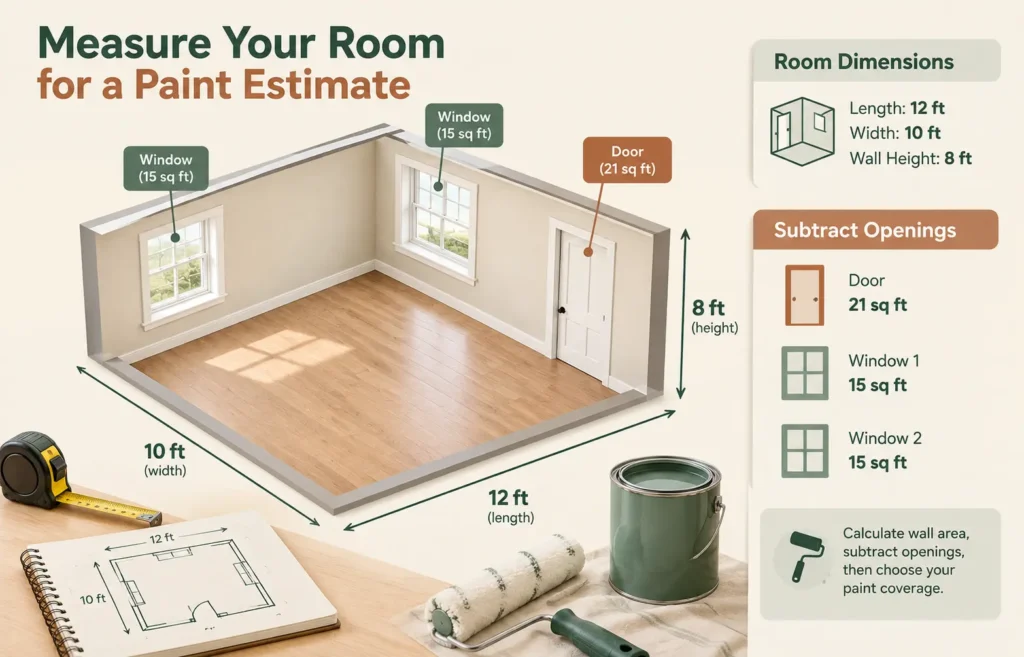
For a rectangular room, measure the room’s length, width, and wall height.
Suppose a room measures:
12 ft long × 10 ft wide × 8 ft high
The perimeter is:
2 × (12 + 10) = 44 ft
Multiply the perimeter by the wall height:
44 × 8 = 352 sq ft
The room therefore has 352 square feet of gross wall area before subtracting doors and windows.
For an irregular room, calculate each wall separately:
Wall area = wall width × wall height
Then add the individual wall areas together.
Subtract Doors and Windows
You usually do not need wall paint for openings that will not be painted, so subtract their area for a more precise estimate.
Measure each opening using:
Opening area = width × height
Actual measurements are preferable to generic estimates.
For the worked example below, we will assume:
One door = 21 sq ft
Two windows = 15 sq ft each
Those figures are assumptions for the example, not standard dimensions that apply to every home.
The total opening area is:
21 + 15 + 15 = 51 sq ft
Subtract that from the gross wall area:
352 − 51 = 301 sq ft
The example room therefore has 301 square feet of paintable wall area.
Account for the Number of Coats
One coat over 301 square feet creates 301 square feet of coating area.
Two coats create:
301 × 2 = 602 sq ft
Do not assume that every project automatically requires two coats. The number of coats depends on the product, existing surface, color change, preparation, and desired finish.
Benjamin Moore, for example, recommends two coats with many of its self-priming paints for full color development and performance, while noting that some previously painted surfaces may receive one or two coats. Follow the directions for the specific product you are using.
Check the Paint’s Coverage Rate
Now find the coverage rate for the paint you plan to buy.
Lowe’s uses 350–400 square feet per gallon as a general planning range for finish paint but specifically advises users to adjust calculations using the coverage listed for the actual paint.
That distinction matters.
For example, BEHR ULTRA Interior lists coverage of 250–400 square feet per gallon, showing how much the expected rate can vary even within common residential paint products.
If the label says your paint covers 350 square feet per gallon, use 350, rather than automatically choosing a generic industry figure.
Convert the Estimate Into Paint You Can Actually Buy
Suppose your calculation says you need 1.89 gallons.
That is the calculated quantity, not necessarily the container quantity you will purchase.
Paint is sold in fixed container sizes. You need enough containers to provide at least the amount calculated for the project.
For a 1.89-gallon requirement, two 1-gallon cans would provide 2 gallons and would normally cover the calculated quantity, assuming the stated coverage rate accurately represents your project conditions.
If the estimate exceeds two gallons, smaller containers such as quarts may sometimes let you purchase closer to the calculated requirement, depending on the product and color availability.
Avoid rounding a paint requirement down simply because the result is close to a convenient container size.
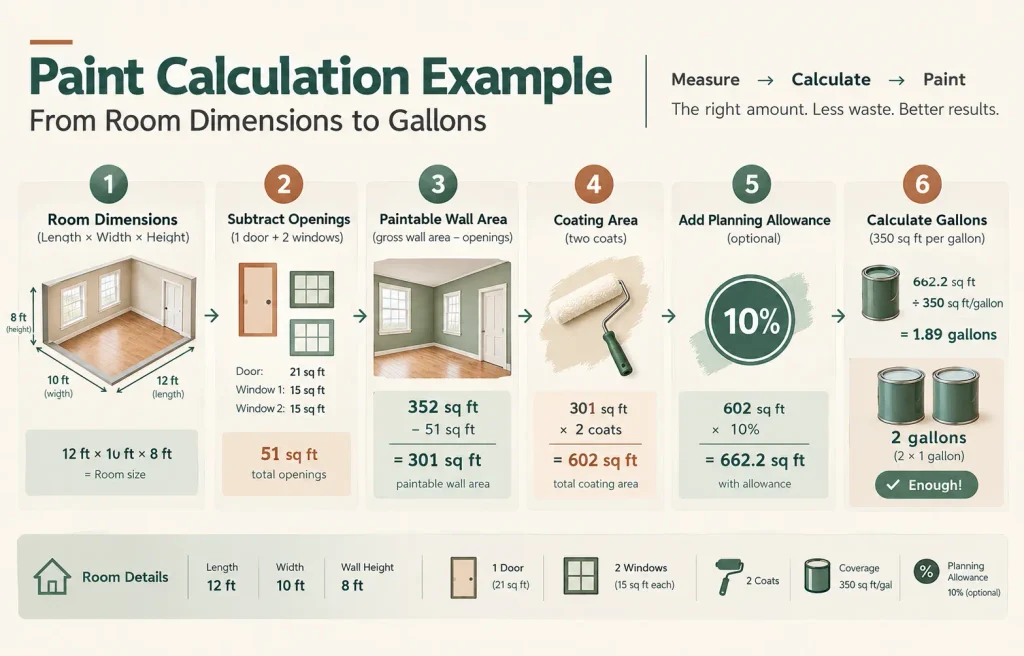
Worked Example: Paint for a 12 × 10 Room
Here is the entire calculation using the example above.
Project inputs
Room: 12 × 10 ft
Wall height: 8 ft
Doors: 1
Windows: 2
Coats: 2
Paint coverage: 350 sq ft per gallon
Planning allowance: 10%
The 350 sq ft coverage rate and 10% allowance are assumptions for this example. Your paint label and project conditions should determine the values used for an actual project.
Step 1: Calculate Gross Wall Area
2 × (12 + 10) × 8
= 352 sq ft
Step 2: Subtract the Openings
Using a 21-sq-ft door and two 15-sq-ft windows:
21 + (2 × 15)
= 51 sq ft
Then:
352 − 51
= 301 sq ft of paintable wall area
Step 3: Account for Two Coats
301 × 2
= 602 sq ft of coating area
Step 4: Add the Optional 10% Planning Allowance
602 × 1.10
= 662.2 sq ft
Step 5: Divide by Paint Coverage
Using the assumed coverage of 350 sq ft per gallon:
662.2 ÷ 350
= 1.892 gallons
Rounded for readability, the project estimate is 1.89 gallons.
The practical purchase would therefore need to provide at least 1.89 gallons of the selected paint. Two 1-gallon cans would provide 2 gallons.
Without the optional 10% allowance, the calculation would be:
602 ÷ 350 = 1.72 gallons
This example shows why the assumptions you enter matter.
Want to run the same calculation with your own dimensions, openings, number of coats, coverage rate, and allowance? Use the HomeBuild Metrics Paint Calculator.
How Much Does a Gallon of Paint Cover?
A common planning estimate for interior paint is about 350–400 square feet per gallon for one coat. Sherwin-Williams currently gives the same approximate range in its paint-calculator guidance.
But treat that as a starting point, not a guarantee.
Coverage varies between products. For example, BEHR ULTRA Interior lists 250–400 square feet per gallon.
Sherwin-Williams also explains that its theoretical coverage calculation does not account for factors such as the texture of the substrate or paint left behind on rollers, brushes, and other application tools.
The most reliable sequence is therefore:
Check the exact paint → find its stated coverage → use that coverage in your calculation.
If you have not selected a paint yet, a planning figure can help with an early estimate, but update the calculation before purchasing once you know the product you will use.
What Can Make You Need More Paint?
A square-foot calculation gives you an estimate. Actual paint use can differ because the surface and application affect how far the paint goes.
Rough or textured surfaces can require more material than smooth walls.
Porous surfaces may absorb more coating, particularly when they are unsealed or inadequately primed.
Additional coats increase the total area that must be covered.
Application method also matters. BEHR notes that coverage can vary with substrate porosity and application method, while some of its published coverage figures specifically exclude material lost during spraying.
A significant color change or difficult-to-hide color may also affect the number of coats required. Some products and colors have specific coating instructions, so the manufacturer’s directions should take priority over a generic estimate.
Should You Add Extra Paint?
Adding extra paint can be useful, but there is no single percentage that every project must use.
An allowance may help account for imperfect measurements, surface texture, application losses, and a small amount of paint for later touch-ups.
For example, adding 10% means multiplying the calculated coating area by:
1.10
A project requiring 602 square feet of coverage would become:
602 × 1.10 = 662.2 sq ft
If your dimensions are precise and your surface is smooth and predictable, you may choose a smaller allowance. A rough or irregular project may justify more.
The important point is to treat the allowance as an adjustable project assumption rather than disguising it as part of the basic paint formula.
What About the Ceiling?
If you are painting the ceiling, calculate it separately from the walls.
For a rectangular room:
Ceiling area = room length × room width
For the 12 × 10 ft example:
12 × 10 = 120 sq ft
If the ceiling receives two coats:
120 × 2 = 240 sq ft of coating area
Then divide that amount by the coverage rate of the ceiling paint.
Keeping the ceiling separate is useful because you may be using a different paint with a different coverage rate.
Is Primer Included in the Paint Estimate?
Not automatically.
If your project needs a separate primer, estimate the primer separately rather than assuming it has the same coverage as your finish paint.
Lowe’s, for example, uses 200–300 square feet per gallon as a general primer planning range compared with 350–400 square feet per gallon for finish paint, while also instructing users to rely on the actual product’s coverage information.
Whether primer is necessary depends on the surface, existing coating, stains, color change, and paint system you are using.
A product marketed as “paint and primer in one” does not automatically mean every project will be completed in one coat. Benjamin Moore notes that its self-priming products may achieve one-coat coverage in some situations but still recommends two coats for full color development and optimal performance.
Follow the preparation, priming, and coating instructions for your specific product.
How Much Paint Do I Need for a 12 × 12 Room?
The room dimensions alone are not enough to give one universal answer.
For example, assume:
12 × 12 ft room
8-ft walls
One 21-sq-ft door
Two 15-sq-ft windows
Two coats
350 sq ft of coverage per gallon
Gross wall area:
2 × (12 + 12) × 8 = 384 sq ft
Subtract the assumed openings:
384 − 51 = 333 sq ft
Two coats:
333 × 2 = 666 sq ft
Paint required:
666 ÷ 350 = 1.90 gallons
Under those assumptions, about 1.90 gallons are required before adding any optional allowance.
With a 10% planning allowance:
666 × 1.10 ÷ 350 = 2.09 gallons
That difference is why quick claims such as “a 12 × 12 room always needs two gallons” can be misleading. Wall height, doors, windows, coats, paint coverage, and the allowance all affect the result.
Should I Subtract Doors and Windows?
Yes, if you want a more precise estimate and those surfaces will not receive the wall paint.
Measure the actual height and width of each opening when practical.
For a quick preliminary estimate, assumed dimensions can be used, but they should be replaced by actual measurements before purchasing paint if accuracy matters.
Do Two Coats Require Twice as Much Paint?
In the basic coverage calculation, yes.
If one coat covers 300 square feet of wall, two complete coats represent:
300 × 2 = 600 square feet of coating area
That doubles the theoretical paint requirement.
Actual consumption can still vary because real-world coverage is affected by the surface, product, and application method.
Does Paint and Primer in One Mean I Only Need One Coat?
Not necessarily.
“Paint and primer in one” generally refers to the product’s self-priming properties; it does not guarantee that one coat will provide the desired hide, color development, or performance for every surface.
For example, Benjamin Moore says that one-coat coverage can sometimes be achieved with its products while still recommending two coats for full color development and optimal performance.
Check the manufacturer’s instructions for your chosen paint and the condition of the surface.
Calculate the Paint for Your Project
The basic calculation is straightforward:
Measure the paintable area → account for coats → use the actual paint coverage → add an optional project allowance → convert the result into a practical purchase quantity.
The most important part is using inputs that reflect your actual project rather than relying on a universal “gallons per room” rule.
For a faster estimate, enter your room dimensions, doors, windows, number of coats, paint coverage, and allowance into the HomeBuild Metrics Paint Calculator.